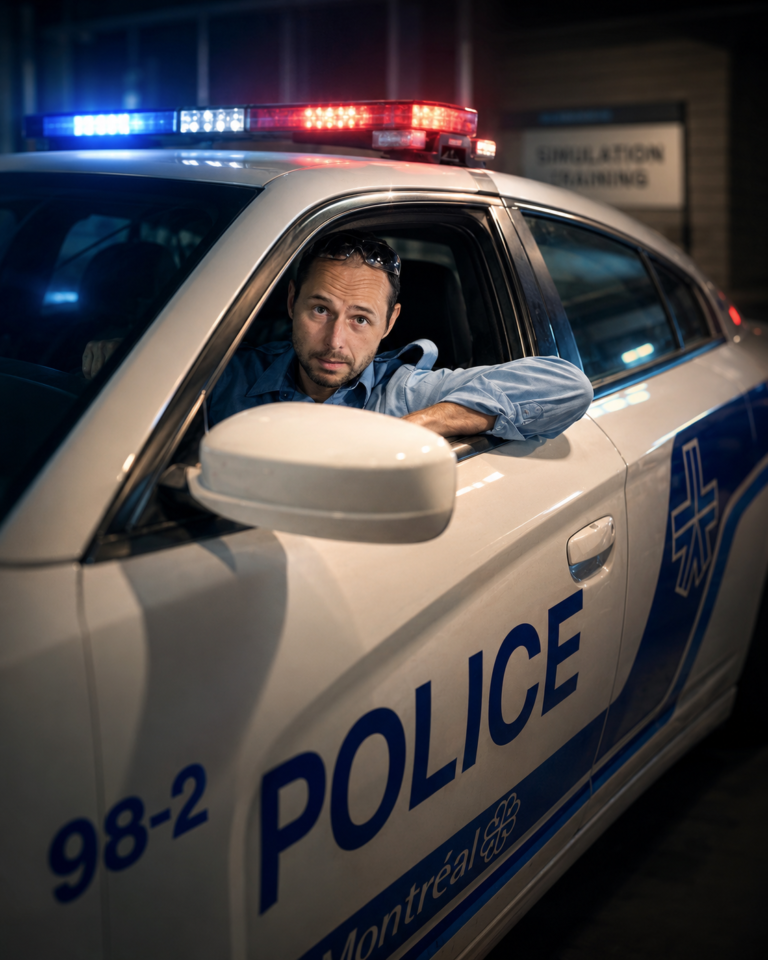
At first glance, playing a patient to help train future doctors, nurses or pharmacists may seem like an unusual branch of the acting profession.
And yet, for the past few years, it is work I have taken part in regularly and find particularly interesting: human simulation in health care.
The principle is simple. I am assigned a patient – sometimes another person who is part of a clinical situation – and I have to portray them credibly and consistently enough to allow students to practise under conditions that resemble real life.
They can learn to ask questions, examine, explain, reassure, make decisions or sometimes make mistakes, without a real patient having to serve as a testing ground.
I am obviously not a doctor, nurse or pharmacist. And that is precisely where my work begins.
My role is to place a human being on the other side of the encounter.
A patient who is not sick… but has to be believable
At Université de Sherbrooke, this approach has a name I really like: the Programme de simulation humaine et de participation citoyenne, or PSHPC.
The principle relies on members of the community who are recruited, trained and supported so they can contribute to the education of future health professionals.
Some become standardized patients and learn specific clinical situations. Others may take part as patient educators or contribute their own experience.
And you do not have to be an actor to do this work.
I find that distinction important because it helps explain what human simulation really is: it is not medical theatre.
As an actor, my goal is certainly not to give a memorable performance.
If someone walks out of an OSCE – an Objective Structured Clinical Examination – thinking, “What an extraordinary actor!”, I have probably missed the point.
The real goal is to become a partner who is believable, precise and consistent enough for the person in front of me to do their work, forget for a few minutes that they are taking part in a simulation, and begin treating the situation like a genuine human encounter.
The strange challenge for an actor: doing it the same way again
In film, two slightly different takes can be interesting. An intention that evolves, an unexpected reaction, a small accident in the acting can even improve a scene.
In clinical simulation, that variation can become a problem.
When an examination puts several students through the same case, each of them essentially has to meet the same patient.
Same story.
Same symptoms.
Same amount of information offered spontaneously.
Same reaction to the right questions.
Same hesitation when a piece of information should only be revealed if the student thinks to ask for it.
That is where the word standardized takes on its full meaning.
McGill University’s Steinberg Centre for Simulation and Interactive Learning, which works with a large pool of standardized patients – including several professional actors – describes this work precisely as reproducing the characteristics of a patient accurately and consistently within a given scenario.
Before an activity, there may therefore be work to do at home, training, and then a rehearsal. When several people play the same character, everyone has to agree on a host of small details so the experience remains fair from one student to the next.
It draws on acting muscles I particularly enjoy: listening, memory, concentration, observation, behaviour rather than demonstration…
And above all, that rather strange ability to do essentially the same thing again and again without starting to play it mechanically.
Some situations, however, offer an exceptional playing field for an actor.
For example, I sometimes portray a patient in psychological distress in encounters that can last twenty-five or thirty minutes. At that scale, it is obviously no longer a succession of a few learned responses. You have to inhabit a character throughout the entire encounter, truly listen to what the person in front of you is saying, react to their questions and the way they intervene, while still respecting the parameters of the scenario precisely.
It is a form of long-form improvisation, but guided improvisation.
I know what my character has lived through, what they feel, what they can reveal, what they keep to themselves and how certain elements are supposed to evolve depending on the student’s interventions. Within that framework, however, there is still an enormous amount of room to listen, feel and react genuinely.
And then you have to be able to start again with the next person without the case gradually drifting into something else.
These are probably the simulations I prefer. They bring together two things that might seem contradictory: a great deal of freedom in the acting and an almost absolute demand for precision. For an actor, it is a fascinating exercise.
On the medical side
Part of my experience has been with medical students and residents.
That can include an OSCE.
The principle is a little like a circuit. The student enters a room, is given a clinical situation and has a set amount of time to complete certain tasks: question the patient, gather their history, perform or explain a physical examination, communicate their reasoning, or sometimes announce and explain something difficult.
Then the station ends.
The candidate leaves.
A few moments later, we start again with someone else.
On my end, the work obviously begins before that day. I have to receive and learn the case, understand what the patient knows, what they do not know, what they volunteer spontaneously and what they will reveal only if the right question is asked. Depending on the situation, there may also be training and a rehearsal with the other participants.
Some scenarios also include elements of a physical examination.
But human simulation does not necessarily mean “playing the illness.”
For example, I took part in an activity where family-medicine and emergency-medicine residents were practising ultrasound of the heart and aorta.
That time, my role was much simpler.
I was essentially… the available human body.
No elaborate character. No particular emotion to reproduce. I simply had to allow doctors to practise a technique properly on a real person before having to perform it in a context where the stakes are much higher.
I really like that dimension of the work.
Sometimes, being useful simply means being there.
On the nursing side
I have also discovered just how important human simulation is in nursing education.
In particular, I took part in an OSCE for nurses pursuing graduate training toward becoming specialized nurse practitioners in primary care.
Here again, knowing the “lines” is far from enough. The person has to be able to observe me, question me, interpret my answers, sometimes examine me, and integrate everything they discover into their clinical judgment.
Université de Sherbrooke also uses human simulation in its nursing programs to work on health interviews, pain assessment, clinical examination and, more broadly, the development of clinical judgment.
Some simulations can also become considerably larger in scale. The program organizes Code Orange exercises, for example: scenarios simulating the arrival of large numbers of injured people.
The scale changes completely. Several patients. Makeup. Simulated injuries. Fake blood. Noise. Partial information. Priorities that change.
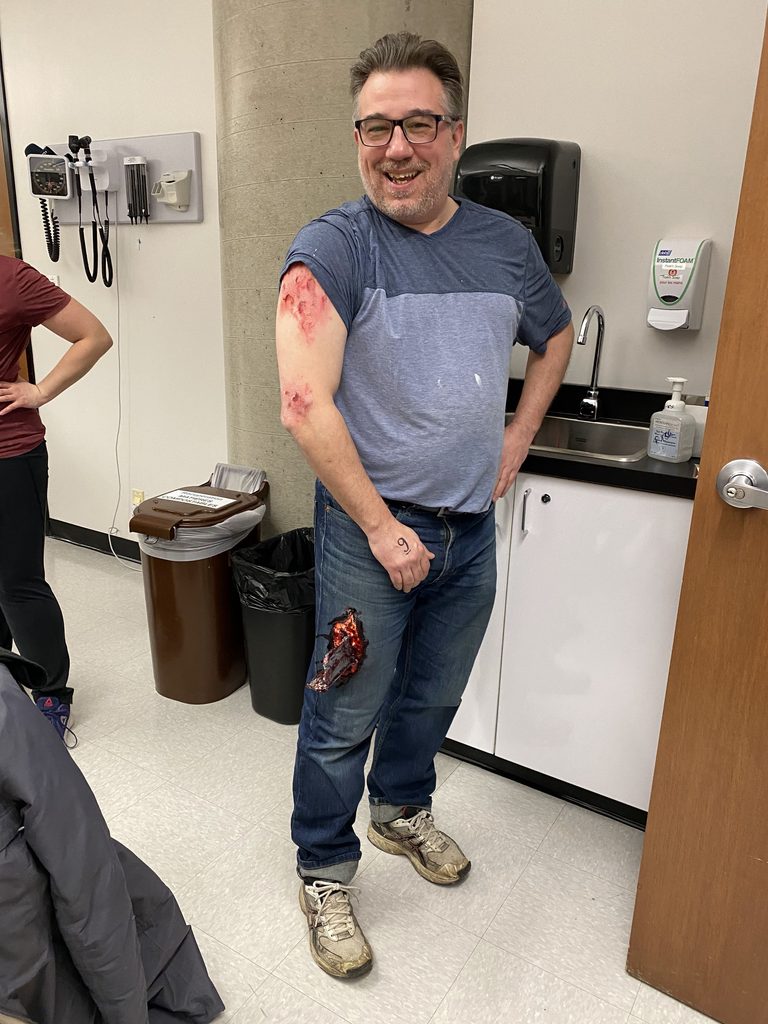
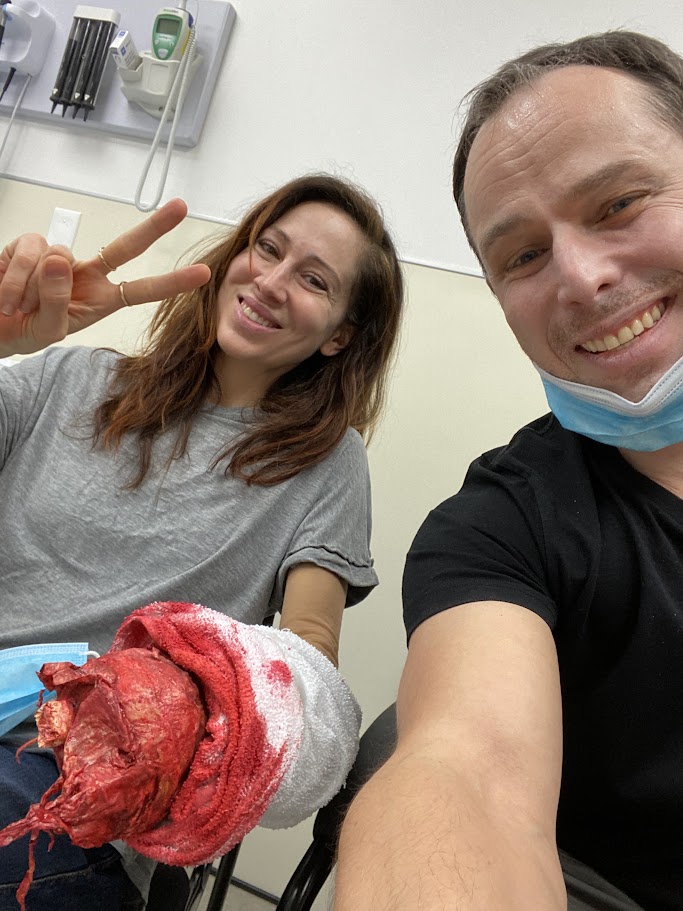
These human simulation images show, on one side, actor Louis-Philippe Desjardins portraying an injured patient with a simulated fragment in his thigh and, on the other, Marie-Hélène Gosselin and me in another simulation setting. Louis-Philippe is an acting partner I have worked with on several shoots and whom I also run into during human simulation exercises with police; Marie-Hélène is also an excellent actor who takes part in this kind of simulation work.
The challenge is no longer simply to conduct a patient interview properly. You also have to triage, collaborate, make decisions and remain functional while several things are happening at once.
It is still a simulation. But for a few moments, the environment does everything it can to make the brain stop treating it like one.
And pharmacy? Much more clinical than you might imagine
It is probably one of the areas people are least likely to associate spontaneously with an actor’s work.
And yet I have also worked as a simulated patient in pharmacy OSCEs at Université de Montréal.
It is easy to picture the pharmacist behind the counter, but the profession obviously involves a considerable clinical and human dimension.
In a simulation station, the future pharmacist is therefore not simply answering a theoretical question about a medication.
They have to interact with someone.
Gather the relevant information.
Understand what medications that person is already taking.
Identify a possible problem.
Explain a situation clearly.
Advise.
Reassure when appropriate.
Or sometimes communicate with another health professional.
Université de Montréal’s Pharm.D. program includes professional simulation activities specifically to develop this kind of skill.
For me, the process is similar to the other simulations: I receive the patient’s file, learn what they know about their situation and which information I should provide only when certain questions are asked. We then rehearse so that the different people portraying the same patient present a situation that is as comparable as possible.
I have also taken part in OSCEs for the Pharmacy Examining Board of Canada, or PEBC.
This time, it is no longer simply an educational activity within a university program. The OSCE is part of the national assessment process leading to pharmacist qualification.
The stations can recreate routine or more critical situations and place the candidate in front of a simulated patient, relative or even another health professional.
I have done this work in French and English.
And when you repeat the same station for a good part of the day with different candidates, you quickly understand why standardization is essential.
The person who walks into the room at three in the afternoon deserves exactly the same chance as the one who came through at eight-thirty in the morning.
Even if, on my end, I am now telling the same story for the fifteenth time.
Centres devoted entirely to simulation
These activities are obviously not unique to one university.
Université de Montréal, for example, has the Centre d’apprentissage des attitudes et habiletés cliniques, or CAAHC, a major simulation environment connected to the Faculty of Medicine. It includes rooms reproducing different clinical settings, interview spaces, high-fidelity mannequins and an entire infrastructure designed to allow students and professionals to practise in controlled situations.
Université de Montréal’s Faculty of Nursing also uses clinical simulation in its training.
McGill, for its part, has the Steinberg Centre for Simulation and Interactive Learning, where different health disciplines come together and standardized patients are recruited and trained specifically for this kind of work.
What I find fascinating is precisely the scale of these infrastructures.
You might think it is simply a matter of asking someone to sit in a room and pretend that something hurts.
In reality, a good simulation often involves instructors, clinicians, simulation specialists, technicians, coordinators, assessors and human participants, all of whom have to contribute to making a few minutes of interaction believable enough for real learning to take place.
A small role in something much bigger
What I probably like most about human simulation is knowing exactly what my place is.
I am not the one teaching medicine.
I do not decide whether the student asked the right questions.
I do not diagnose anyone.
And I certainly do not pretend to possess the knowledge of the instructors and professionals who design these activities.
I am the one who gives them someone in front of whom they can put that knowledge into practice.
Someone who answers.
Who hesitates.
Who does not always understand the question the first time.
Who worries.
Who may be in pain, afraid, impatient, embarrassed, or simply need someone to explain more clearly what is happening.
And for a few minutes, that “someone” has to seem real enough for the person in front of me to stop reciting what they have learned and start communicating with a human being.
It is a fairly discreet use of the acting profession.
There is no audience.
No credits.
And usually no images to show afterward.
Confidentiality is naturally part of this work as well. Assessment scenarios and, especially, what happens with students or candidates do not belong outside the room.
But I sometimes come away from it with a very particular kind of satisfaction.
Because somewhere during that day, a future doctor, nurse or pharmacist may have tried something for the first time.
Maybe hesitated.
Maybe asked the wrong question.
Maybe forgotten something.
And maybe learned from that mistake in front of me rather than in front of their first real patient.
That seems to me like a very good way for an actor to make themselves useful.