Sometimes I get a detailed character breakdown, with specific things to do and lines I have to deliver word for word. Other times I have plenty of room to improvise. Either way, once a police officer is standing in front of me, the scene has to come off the page.
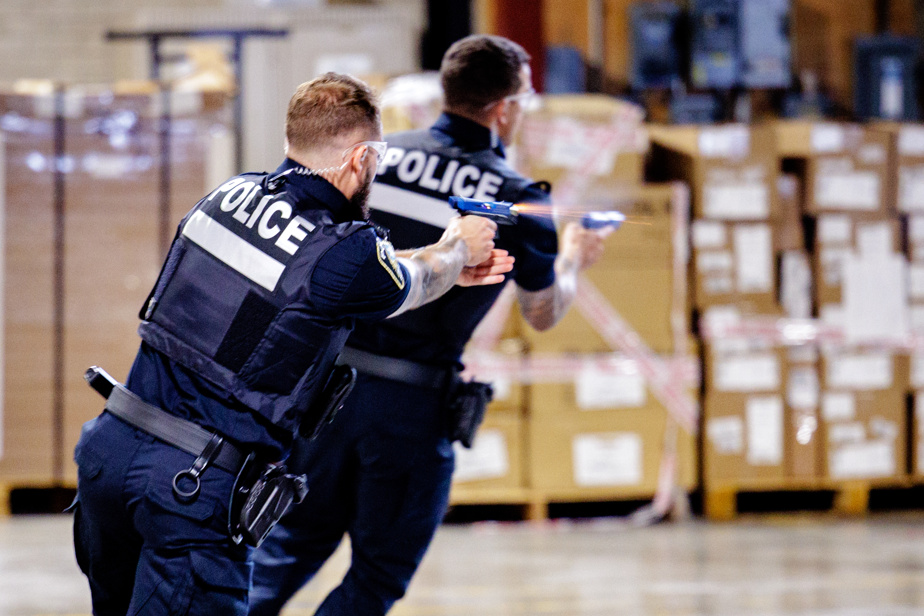
For the past few years I’ve worked as an actor, and sometimes as a stunt performer, in police training simulations. The instructors design the exercise, decide what they want participants to practise and assess how it goes.
I play the person the officer has to talk to.
An audience of one
On a film set, my character serves a story an audience will see later. In a simulation, the person I’m speaking to needs to be able to pick up on something I do, decide what to say to me and see how I respond.
I might play someone who’s calm, worried, impatient, wary, confused or shaken. My character might understand exactly what’s going on, or see the situation quite differently from the officer.
A reaction can be interesting to play and still get in the way. If I throw in an emotion or a piece of information because I think it makes for a better scene, the person in front of me suddenly has a different problem to solve.
In Nicolet, the École nationale de police du Québec (ENPQ) has its own team of actors, the Service des comédiens. The school describes their work (in French). How a character responds depends on what the participants are there to learn. Afterwards, the character’s point of view can give everyone something to discuss. Saying “I thought you’d stopped listening to me” is different from guessing what the other person was thinking. It gives both people a particular moment in the encounter to go back to.
How closely do you stick to the script?
That’s one of my favourite things about the work. Two exercises can ask very different things of me.
Some scenarios spell out what my character knows, what I can reveal, when I have to do something and which lines I need to get exactly right. The same detail has to survive several runs. It’s a lot like continuity on a film set.
In a more open exercise, I know who I’m playing, what’s happened to them, how they feel and what they want. I know the limits of the scene. How the other person will speak to me, though, is anybody’s guess. As an actor, I love that.
I have to listen. I can know exactly where my character starts without knowing how they’ll feel when the encounter is over. The ground rules give me a solid enough starting point that I can afford to be surprised.
When nobody knows the next line
In a more open simulation, the officer hasn’t seen my lines and I haven’t seen theirs. The way they ask a question can change my answer. A tone of voice can earn my character’s trust. A misunderstanding might linger even after the officer thinks it’s been cleared up.
My job is to let the encounter affect me and still remember the terms of the exercise. It calls for a different kind of improv than a scene where anything goes.
Sometimes I have to resist an actor’s instinct to help a scene partner out. On stage I like giving the other actor something to work with. Here, if I volunteer something the officer was supposed to discover, I’ve done part of their job. Sometimes I need to let the silence sit. Otherwise I’m just a prompter in costume.
Playing a person in distress
Some of my favourite simulations ask me to play a person in distress. I’ve been called to Nicolet several times for that kind of scene. The ENPQ also describes a practical de-escalation course (in French) that uses role-play and is delivered within police and public safety organizations.
There’s a lot for me to explore as an actor. It’s also an easy role to turn into a caricature.
What has this particular person understood? What are they afraid of? Someone can want help and still turn down the help they’re offered. Another person might be just as distressed and barely say a word.
If I understand my character’s reasoning, even a surprising response can make sense. Then I can really listen to the officer and let what they do shape what happens between us.
Some scenes run long enough that I use up any reactions I had in mind. I settle into the character and listen. Holding a complicated feeling for that long without cranking it up is about as close to pure acting as it gets for me.
Starting over without going through the motions
Then I have to start again. And sometimes again.
If several officers take turns in the same exercise, they each deserve a comparable starting point. I can’t make the character easygoing for the first person and difficult for the next just because I feel like trying something.
I have to remember what my character knows, what they’ll volunteer and how they feel when the scene starts. If we run it three times, all three participants should have the same chance to uncover a piece of information. What they do with it is up to them.
After a few runs, I can practically hear the next question before it’s asked. That’s the trap. The person across from me might be doing this for the first time. My character needs to hear the question for the first time too.
I draw on that same discipline when I play a standardized patient in medical training. I need to repeat a scene accurately and leave room for the person who’s just walked in.
A different kind of continuity
Starting a scene over and keeping it alive reminds me of working on a film set.
I might have to come back to a scene hours later, with the camera in a different place, and find the same mood, timing and movements again. The setup is different in a simulation, but it works a similar muscle.
I need to remember what my character knows, what just happened to them and where they are emotionally. Once I have those things back, I can let something new happen.
One contract can ask me to learn lines, improvise and keep track of continuity right down to how I answer someone. I don’t often get to work on all three at once.
When the role gets physical
Some scenes ask more of me physically. That’s where my experience as a stunt performer comes in.
I have to stay aware of my body, the space and the safety limits set by the people running the exercise. Some simulations also call for protective equipment.
If you’re offered a physical role, it’s worth asking a plain question before you agree to it. What exactly will you be asked to do, and who’s supervising that part of the work?
As on a film set, my character can look out of control while I know exactly what I’m doing. I need to be able to do it again with the next person, too.
I’ve worked on several of these training sessions, sometimes as an actor and sometimes as a stunt performer.
From Nicolet to Boucherville
This work has taken me to activities with Montréal’s police service (SPVM), to the ENPQ in Nicolet several times, and to Boucherville, where the Service de police de l’agglomération de Longueuil (SPAL) has its training centre. I’ve also taken part in police training in Laval.
In Nicolet, the ENPQ even has a mock police station. In Montréal, the SPVM explains that professional actors and its own coaches both play roles in one of its de-escalation training programs. The SPAL opened its Boucherville centre in 2022. Its 2023 report describes practical training in communicating with people in crisis.
That’s where having an actor in the room makes a difference. You can plan a question in a classroom. It feels different asking someone the question and waiting for their answer.
A look at Montréal police recruits
In October 2023, La Presse ran a feature on the training of new Montréal police officers.
Available in French.
A related role in correctional training
I’ve also acted in training for correctional officers. Policing and corrections are different jobs. What carries over for me as an actor is the encounter with someone who needs to put their training into practice.
In some of the correctional exercises I took part in, we got our roles on site. There were no lines to memorize. I had to pick up the character and the situation quickly, then make the encounter just as believable for the next group.
In the exercises I took part in, the instructors did the teaching. My job was to give them a situation with someone in it who could answer back.
An odd sort of acting lab
In one exercise I might have to get a handle on a character quickly, deliver an exact line, match a movement or adjust to a long silence. What interests me is shifting between those things and still listening to my partner.
Sometimes my best acting choice goes completely unnoticed.
Some of these jobs are emotionally demanding or physically intense. On others, I spend most of the scene listening and give a very simple answer. Both can take just as much precision.
That’s probably my favourite thing about the job. When it’s going well, the person across from me can forget I’m acting.
A scene with no spectators
On set, I usually know where the camera is. I might have exact lines to say. The director can call cut, try a different take, and decide later, in the edit, what the audience will see.
In a simulation, the other person is inside the scene with me. There’s no edit to tidy up the exchange.
If the scene is scripted, I stick to the lines. If it’s open, I accept that I don’t know where it will go. My favourite place is often somewhere in between. I know exactly what I can count on, but I have no idea what the other person is about to say.
Meeting the next participant
I’ll probably never know what these simulations change for the officers I meet. That’s for the instructors to assess. When the exercise ends, they carry on with their work and I go back to my starting point to meet the next person.
What I can give them, for a few minutes, is someone to observe, listen to and understand. Depending on what the scene calls for, I might give exactly the answer they expected. Or I might let another moment go by before I speak.
Then we stop, reset and start again. As an actor, I couldn’t ask for a better place to practise.