Notes from a social clown workshop in a CHSLD (long-term care centre)
A few days ago, I went through a deeply moving human experience: an intensive three-day training in social clowning, led by the extraordinary Élise Deguire.
Slowing Down to Be Present
This was not training in the traditional sense. It was a journey. Élise, an experienced clown, artist and instructor, gently invited us to slow down, to listen, and to make ourselves available. Trained in physical theatre and active for years with Dr Clown, she cultivates a sensitive approach rooted in human connection. What she passes on is an inner stance. An art of being with another person, fully and simply.
The intensive workshop unfolded over three days, from Friday to Sunday. The first day was devoted to games and exercises that allowed us to get to know one another as participants while beginning to explore the vulnerable, precious human connection at the heart of social clowning. We spent Saturday and Sunday mornings in a CHSLD. Each day, we began in the secured unit for people with cognitive impairments: residents living with dementia, Alzheimer’s disease or other neurodegenerative conditions. We then continued our visits in a non-secured wing, meeting seniors with reduced mobility either in their rooms or in the common areas. This was not a place for performance. It was a place for encounters. For glances. For sighs. For fragile laughter. For silences filled with presence. It was not about “doing” clown, but about being there. Letting ourselves be moved by whatever arose. Inhabiting the moment with another person. Nothing more, nothing less.
Learning to Unlearn
What I learned—or rather unlearned—during those three days was just how deeply our humanity reveals itself in the simplicity of connection.
Not in the effort to entertain.
Not in the ambition of making a scene work.
But in daring to show ourselves: vulnerable, attentive, available.
Another fundamental lesson was humility: the social clown makes themself small, lowering themself in order to lift the other person up. You have to accept being awkward, stumbling in your intentions, sometimes entering moments when everything is uncertain, when you no longer know what to say or do—and that is precisely where the magic begins. Those slightly fragile moments, when you feel at a loss in the face of a resident’s vulnerability, or when you gently laugh at your own awkwardness, are often the moments when the connection becomes most moving. Moments when doing must fall silent to make room for being.
Seeing, Without Trying to Be Seen
The social clown is not necessarily a character. It is an opening. A benevolent image, a fleeting moment, a pause. Permission to exist differently, with the sole intention of doing some good.
And in this delicate dance, between clumsy gestures and sincere impulses, between hands extended and hands held, I felt something immense.
Something simple.
Something alive.
An art that does not seek to shine.
But warms.
An art that does not seek to be seen.
But sees.
And what if, in the end, that were the real stage?
The one where we do not play a role.
But where we give of ourselves sincerely, without holding back.
Gratitude and Fellow Travellers
We owe this journey first of all to Julie Guénette, a clown artist and friend with a heart as big as her contagious laugh, who planted this idea one day and drew us into it with all her generosity. And then there is Élise. Élise, who welcomed us with a steady tenderness, who guided us step by step, who made us feel safe just enough for us to venture without a net through the floors of CHSLD Philippe-Lapointe, under the caring supervision of Michèle Lemay, recreation coordinator.
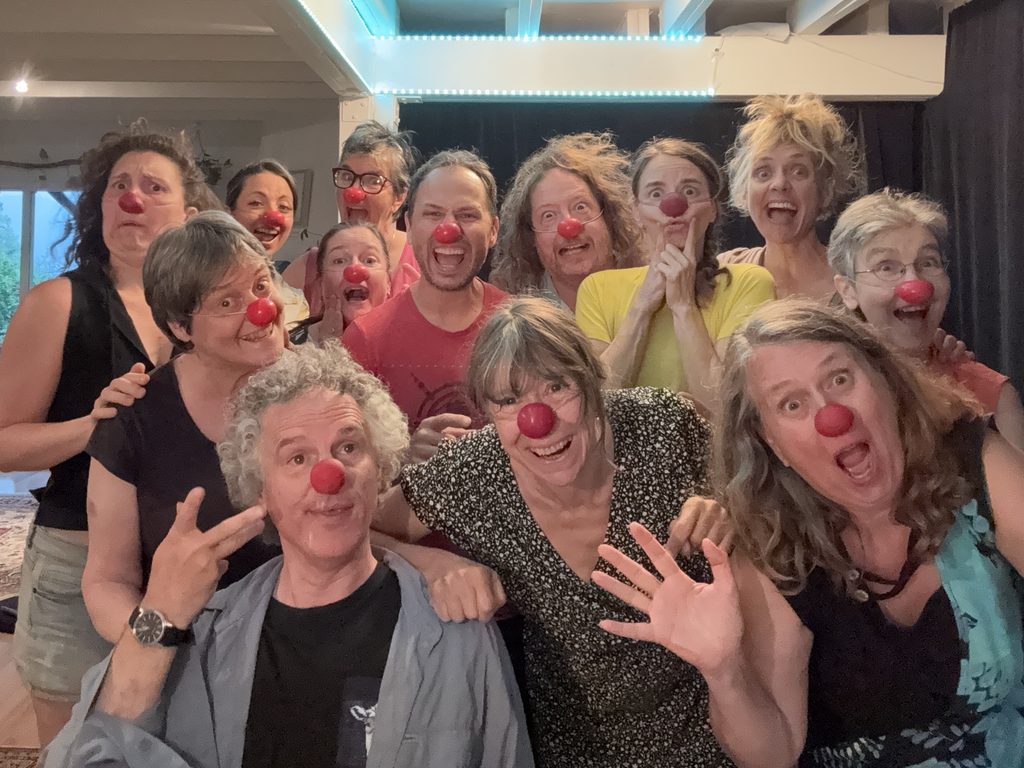
Clémentine and Roger… No, Claude
As for me, if I was able to make this journey, it was thanks to Annick. My love, my compass, my anchor in this adventure. She connected me to this whole beautiful world. She opened the door to it with her simple, steady presence.
Annick was radiant throughout the weekend. As her clown, whom she named Clémentine, she radiated a quiet joy, a contagious gentleness, and a tender attentiveness that went straight to the heart. Sometimes she was the one who opened the door to a connection, beginning a silent dance with a resident while I stayed back, respectful, a witness. Other times, she passed me the baton with a knowing glance, inviting me into the play.
My own clown, openly in love with his beautiful Clémentine, was named Roger, but insisted that everyone call him by his stage naaaame: Claude. A mover by trade (self-proclaimed), capable of hoisting dryers in his arms.
And it was this duo, quiet but united, sometimes taking turns, sometimes side by side, that gave this experience its unforgettable hue—something invisible yet deeply felt.