At first glance, playing a patient to help train future doctors, nurses or pharmacists may seem like an unusual branch of the acting profession.
Yet it’s work I’ve done regularly for a few years now. It’s called human simulation in health care, and it’s a part of acting I’ve come to enjoy.
I’m given a patient to play, sometimes a relative or someone else involved in the encounter. I have to find a way of speaking and reacting that feels real and that I can reproduce, so the students can work with me.
They can learn to ask questions, examine, explain, reassure, make decisions or sometimes make mistakes, without a real patient having to serve as a testing ground.
The students are the ones putting their clinical knowledge into practice.
My role is to place a human being on the other side of the encounter.
A patient who is not sick… but has to be believable
At Université de Sherbrooke, I like the name they’ve given this work. They call it the Programme de simulation humaine et de participation citoyenne (in French), or PSHPC.
The university recruits people from the community and trains them to take part in health professions education.
The role depends on the activity. A standardized patient learns a case. A patient educator helps learners practise certain physical examinations. Other participants come to share their own experience as patients.
If you’re curious about doing this work, Sherbrooke says you don’t need theatre classes to apply. The program trains participants, pays standardized patients and lists its needs by campus.
I like that people find their way into this work from such different places. Stage experience can help, but the encounter doesn’t revolve around me.
As an actor, it’s a funny thing to hope for. Ideally no one notices how much preparation went into it.
If someone walks out of an OSCE (objective structured clinical examination) thinking, “What an extraordinary actor!” I’ve probably missed the point.
What I’m hoping for is that a few minutes in, the person across from me is dealing with this patient as someone they’ve genuinely just met.
The strange challenge for an actor: doing it the same way again
In film, two slightly different takes can be interesting. An intention that evolves, an unexpected reaction, a small accident in the acting can even improve a scene.
In clinical simulation, that variation can become a problem.
When an examination puts several students through the same case, each of them essentially has to meet the same patient.
Same story.
Same symptoms.
Same amount of information offered spontaneously.
The same reaction when someone asks for the same piece of information.
Same hesitation when a piece of information should only be revealed if the student thinks to ask for it.
That is where the word standardized takes on its full meaning.
McGill’s Steinberg Centre for Simulation and Interactive Learning trains standardized patients, many of them professional actors. A scenario can also call for a family member or another health professional. McGill’s standardized patient role description says the centre may train participants to give feedback on the encounter. A made-up example gives you a sense of whose perspective matters here. “When you said I could interrupt you, I felt comfortable enough to ask my question.”
Before an activity, there may therefore be work to do at home, training, and then a rehearsal. When several people play the same character, everyone has to agree on a host of small details so the experience remains fair from one student to the next.
It draws on acting muscles I particularly enjoy. It takes memory, listening and an eye for the little things that bring someone to life.
And above all, that rather strange ability to do essentially the same thing again and again without starting to play it mechanically.
Some situations also give me a surprising amount of room to play.
Sometimes I play a patient in psychological distress for twenty-five or thirty minutes. I have to stay with that person for the whole encounter, listen to what the learner actually says and respond to the way they approach me, all within the limits of the case.
It’s a long improv with some very clear boundaries.
I know what my character has lived through, what they feel, what they can reveal, what they keep to themselves and how certain elements are supposed to evolve depending on the student’s interventions. Within that framework, however, there is still an enormous amount of room to listen, feel and react genuinely.
And then you have to be able to start again with the next person without the case gradually drifting into something else.
These are probably the simulations I prefer. They bring together two things that might seem contradictory: a great deal of freedom in the acting and an almost absolute demand for precision. For an actor, it is a fascinating exercise.
On the medical side
Part of my experience has been with medical students and residents.
That can include an OSCE.
The principle is a little like a circuit. The student enters a room, is given a clinical situation and has a set amount of time to complete certain tasks: question the patient, gather their history, perform or explain a physical examination, communicate their reasoning, or sometimes announce and explain something difficult.
Then the station ends.
The candidate leaves.
A few moments later, we start again with someone else.
On my end, the work obviously begins before that day. I have to receive and learn the case, understand what the patient knows, what they do not know, what they volunteer spontaneously and what they will reveal only if the right question is asked. Depending on the situation, there may also be training and a rehearsal with the other participants.
Some scenarios also include elements of a physical examination.
But human simulation does not necessarily mean “playing the illness.”
For example, I took part in an activity where family-medicine and emergency-medicine residents were practising ultrasound of the heart and aorta.
That time, my role was much simpler.
I was essentially… the available human body.
No elaborate character. No particular emotion to reproduce. I simply had to allow doctors to practise a technique properly on a real person before having to perform it in a context where the stakes are much higher.
I really like that dimension of the work.
Sometimes, being useful simply means being there.
On the nursing side
I have also discovered just how important human simulation is in nursing education.
One OSCE I took part in was for nurses doing master’s-level training to become primary care nurse practitioners.
Here again, knowing the “lines” is far from enough. The person has to be able to observe me, question me, interpret my answers, sometimes examine me, and integrate everything they discover into their clinical judgment.
At Université de Sherbrooke, nursing simulations give students a chance to observe, ask questions and exercise their clinical judgment.
In 2024 the university documented a Code Orange nursing simulation in Sherbrooke and Longueuil (in French). Instead of one patient, the teams faced a sudden influx of simulated casualties.
The scale changes completely. Several patients. Makeup. Simulated injuries. Fake blood. Noise. Partial information. Priorities that change.
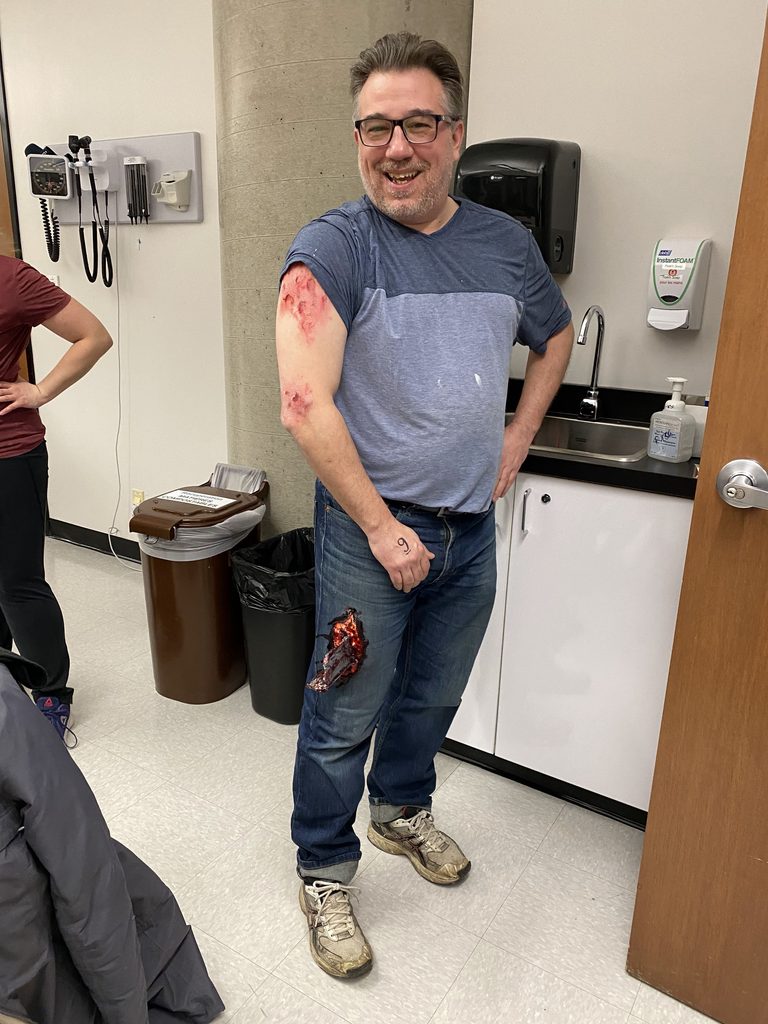
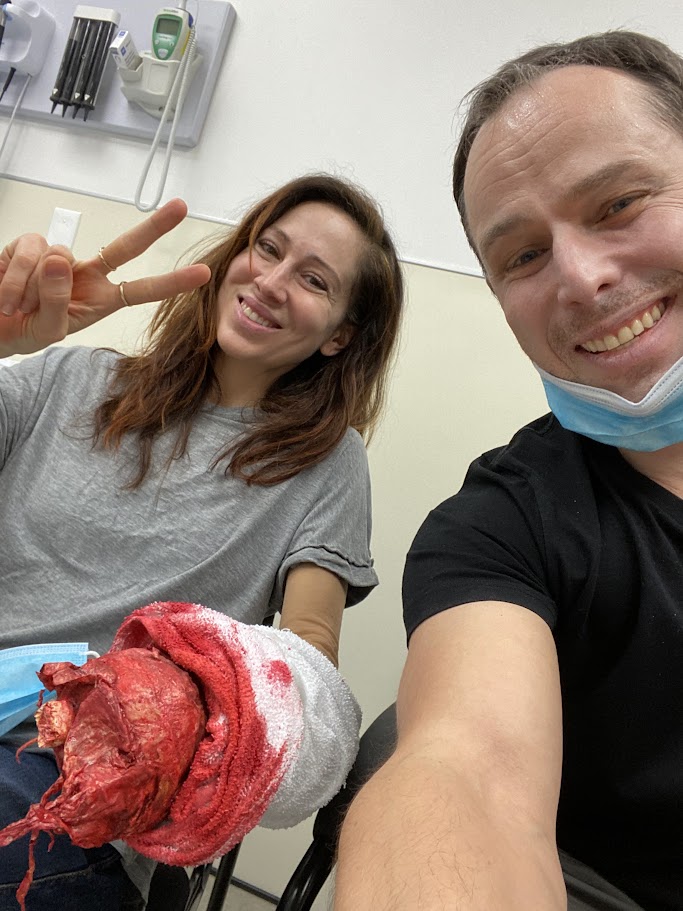
In the first photo, actor Louis-Philippe Desjardins plays an injured patient with a simulated fragment in his thigh. We’ve been on a few shoots together, and I run into him in police training simulations as well. In the second photo I’m with Marie-Hélène Gosselin, a terrific actor who also does this kind of work.
The challenge is no longer simply to conduct a patient interview properly. You also have to triage, collaborate, make decisions and remain functional while several things are happening at once.
It is still a simulation. But for a few moments, the environment does everything it can to make the brain stop treating it like one.
And pharmacy? Much more clinical than you might imagine
It is probably one of the areas people are least likely to associate spontaneously with an actor’s work.
And yet I have also worked as a simulated patient in pharmacy OSCEs at Université de Montréal.
It is easy to picture the pharmacist behind the counter, but the profession obviously involves a considerable clinical and human dimension.
In a simulation station, the future pharmacist is therefore not simply answering a theoretical question about a medication.
They have to interact with someone.
Gather the relevant information.
Understand what medications that person is already taking.
Identify a possible problem.
Explain a situation clearly.
Advise.
Reassure when appropriate.
Or sometimes communicate with another health professional.
In Université de Montréal’s entry-to-practice Pharm.D. program, students practise communicating with other professionals in labs that simulate hospital and community pharmacy settings.
For me, the process is similar to the other simulations: I receive the patient’s file, learn what they know about their situation and which information I should provide only when certain questions are asked. We then rehearse so that the different people portraying the same patient present a situation that is as comparable as possible.
I’ve also worked as a simulated patient in OSCEs for the Pharmacy Examining Board of Canada (PEBC).
Here the OSCE is Part II of the Pharmacist Qualifying Examination. It’s a national exam. Licensing is provincial or territorial. The board’s guidance on licensing identifies Quebec as the exception to the general requirement for its certificate.
The stations can recreate routine or more critical situations and place the candidate in front of a simulated patient, relative or even another health professional.
I have done this work in French and English.
And when you repeat the same station for a good part of the day with different candidates, you quickly understand why standardization is essential.
The person who walks into the room at three in the afternoon deserves exactly the same chance as the one who came through at eight-thirty in the morning.
Even if, on my end, I am now telling the same story for the fifteenth time.
Centres devoted entirely to simulation
These activities are obviously not unique to one university.
At Université de Montréal’s Faculty of Medicine, the Centre d’apprentissage des attitudes et habiletés cliniques (CAAHC) designs simulations that let students practise in different clinical settings.
Université de Montréal’s Faculty of Nursing has its own simulation centre, the Centre d’expertise en simulation en santé (EXeSS).
At McGill’s Steinberg Centre, coordinators prepare standardized patients for the particular goals of each activity.
What I find fascinating is precisely the scale of these infrastructures.
You might think it is simply a matter of asking someone to sit in a room and pretend that something hurts.
In reality, a good simulation often involves instructors, clinicians, simulation specialists, technicians, coordinators, assessors and human participants, all of whom have to contribute to making a few minutes of interaction believable enough for real learning to take place.
A small role in something much bigger
What I probably like most about human simulation is knowing exactly what my place is.
The clinical team handles the medical teaching.
In a PEBC pharmacy OSCE, a trained assessor watches the candidate and scores their work against a common set of criteria.
From my chair, I have a different job.
Even when I know the question that’s coming, I wait to be asked.
I give the person practising someone to talk to.
Someone who answers.
Who hesitates.
Who does not always understand the question the first time.
Who worries.
Who may be in pain, afraid, impatient, embarrassed, or simply need someone to explain more clearly what is happening.
And for a few minutes, that “someone” has to seem real enough for the person in front of me to stop reciting what they have learned and start communicating with a human being.
It is a fairly discreet use of the acting profession.
There is no audience.
No credits.
And usually no images to show afterward.
Confidentiality is part of the job. I can talk about what the work asks of me as an actor while keeping the exam cases and each candidate’s performance private.
But I sometimes come away from it with a very particular kind of satisfaction.
Because somewhere during that day, a future doctor, nurse or pharmacist may have tried something for the first time.
Maybe hesitated.
Maybe asked the wrong question.
Maybe forgotten something.
And maybe learned from that mistake in front of me rather than in front of their first real patient.
That seems to me like a very good way for an actor to make themselves useful.