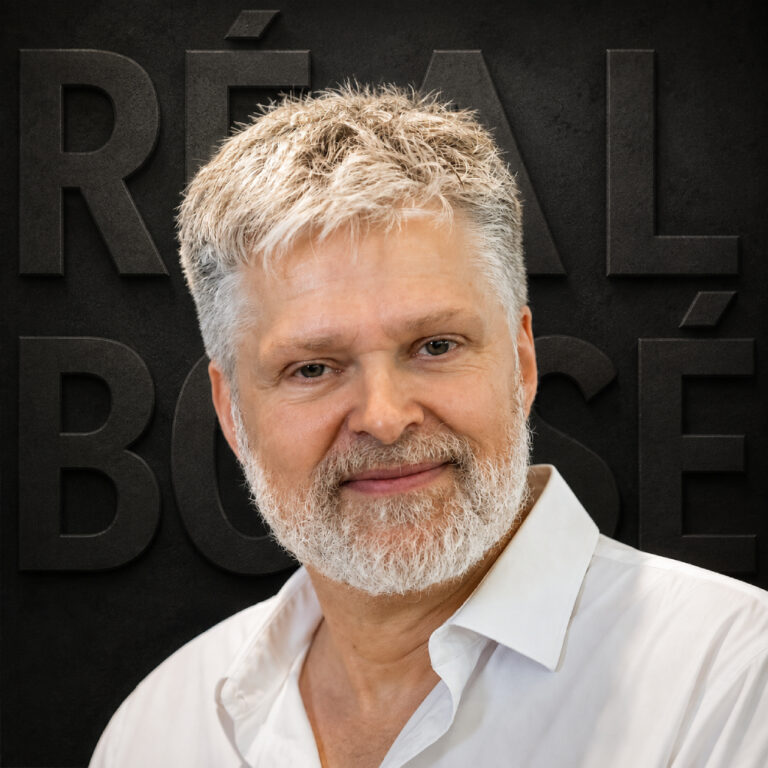
I took stage-combat training with Shawn Baichoo at Montreal’s Triple Threat Academy in early 2023. I arrived with plenty of enthusiasm, obviously. Learning how to throw a punch, receive an attack, build a fight and understand a little more about the world of stunt fighting has a frankly playful appeal when you are an actor. But I quickly discovered that stage combat was much more interesting than simply learning how to “pretend to fight.”
A good fight scene rests on a fascinating paradox: everything has to look as though it could spin out of control at any moment, while in reality almost nothing should be left to chance. Distance matters. Trajectory matters. Rhythm matters. Your partner matters enormously. And in the middle of all that machinery, you still have to act. That is probably what interested me most in the training with Shawn.
The fight begins long before the first punch
A fight in film or theatre can look brutal, instinctive and chaotic. For the actors performing it, the reality is almost the opposite. You need to know where you are going, know the movement, respect the distance, make sure your partner knows what is coming, and give the audience or camera exactly the angle required for a punch that never actually lands to look completely convincing. Then you have to do it again.
That degree of precision could easily make the result feel cold or mechanical. Once it is integrated, however, it often does the opposite: it frees the actor. When I know where the arm is travelling, where I need to be and how my partner is going to respond, I can go back to the scene. Why am I hitting this person? Why do I hesitate? Do I actually want to hurt them, or only frighten them? Am I defending myself? Losing control? Have I just realized I am much less powerful than I thought? Suddenly we are no longer choreographing a string of hits. We are telling a story.
Your partner is the person who allows you to look dangerous
One thing stage combat makes extremely obvious is how much our partner contributes to our own performance. A great stage punch does not depend only on the person throwing it. The person receiving it has to sell it too. They have to react at the right moment, with the right size of movement and in the right direction. They are part of the illusion. In other words, I cannot look spectacular all by myself.
I find that especially interesting because the same truth goes far beyond combat. It applies to almost every scene we play. My partner is constantly giving me the possibility of existing in the scene. They send me something, I receive it, and I send something back. When that circulation disappears and we each start acting inside our own little bubble, you can almost always see it.
With Shawn, the physical nature of the work made that interdependence impossible to ignore. If I do not genuinely listen to my partner in a dialogue scene, the scene will probably be worse. If I do not listen to them in a fight, someone may also receive a forearm somewhere it was never supposed to go. That clarifies the priorities fairly quickly.
Choreography is not yet a scene
You can learn a sequence of movements perfectly and still produce something completely empty. Punch, block, return, dodge, fall: technically impeccable. But why?
That is where combat becomes acting again. The character obviously does not know the choreography. They do not know that on the fourth movement they are going to take a hit and on the sixth they will turn the situation around. They are simply trying to survive, attack, escape, protect someone or get something. The actor knows everything. The job is to know the structure so thoroughly that you can make it look as though it is happening for the first time.
I find that a wonderful exercise in presence. We know exactly what will happen, yet we still have to preserve the scene’s ability to surprise us. It is not so different from dialogue we know by heart. I know what my partner is about to say. I know my next line. But if I simply start waiting for my turn to speak, the scene dies. Stage combat makes the same mechanism much more visible.
Sell the hit without revealing the trick
There is something fascinating about the illusion itself. On film, a fist can pass a safe distance from someone’s face and still look brutal because of the camera angle, the receiver’s movement, the timing and, eventually, sound added later. Onstage, you build the same kind of illusion while accounting for the audience’s point of view.
Everything is therefore extremely precise. But the viewer should never be thinking about that precision. They should not be thinking, “Nice safety distance.” They should be thinking, “Ouch.” That is it.
I love that principle because it exists everywhere in the profession. We spend enormous amounts of time learning technique so that eventually nobody notices it. An actor may work on voice, marks, framing, eyeline, breath, continuity, text and rhythm. When a scene works, the audience is not supposed to admire all that labour. It is supposed to forget the labour exists. Stage combat pushes the idea almost to the point of absurdity: enormous control used to create the impression of complete loss of control.
The body tells the story too
The training also reminded me how much an actor’s body contributes to storytelling. Two characters do not receive the same punch in the same way. Someone accustomed to fighting will probably not move like someone taking the first punch of their life. A terrified character will not have the same centre of gravity as a character actively looking for confrontation.
There is therefore a whole layer of acting that begins before the choreography itself: posture, the way you advance, how you protect your face, how long it takes before you dare hit back, the response to pain, the exact moment fear becomes anger, or anger becomes fear. That is when combat becomes genuinely interesting for an actor. Movement stops being something laid on top of the scene and becomes another way of telling us who the character is.
Shawn: an actor first
That is also what I liked about the way Shawn taught the work. His career obviously includes stage combat, stunts and choreography, but he is also very much an actor. His work has taken him through theatre, film, television, voice work, dubbing, video games and performance capture. He has contributed voice and performance work to characters in Watch Dogs, Rainbow Six, Assassin’s Creed and Outlast.
You can feel that versatility in his approach. It is never only about executing a physical technique. The technique still has to belong to the character and the scene. In video games and performance capture, that becomes particularly obvious: body, voice and acting sometimes have to work together in an environment where part of the final world does not even exist in front of the performer yet. You have to be technically precise while continuing to create something alive.
That combination of precision and acting is very close to what I found in Shawn’s stage-combat teaching.
Serious about the work, not heavy about the atmosphere
I started the training excited, and from the first classes I remember thinking the experience was frankly amazing. The work was serious. Safety had to be serious. Precision had to be serious. Learning, however, did not have to feel heavy.
That is probably one of the qualities I remember most about Shawn as a teacher. He has an extremely specialized skill set without surrounding it with an intimidating or inaccessible aura. We work, repeat and correct things, but we can also have an enormous amount of fun doing it.
I value that combination in a teacher. In some disciplines, awareness of risk can make everyone tense. Stage combat could certainly become one of them. But once a clear framework is established and everybody understands their responsibility, trust creates more freedom. Then you can begin to play.
A skill that goes far beyond fight scenes
I came out of the training with much more than a few fighting techniques. I found many of the fundamentals of acting inside it: listening, timing, awareness of a partner, control of the body, precision, repeatability, the ability to receive a note, and especially the difference between doing more and doing something more precisely.
“Give it more energy” is not always the solution. Better distance might be. A clearer movement. A more truthful reaction. A fraction of a delay before striking back. A glance toward the wrong exit before realizing you are trapped. Often intensity comes from precision rather than agitation.
That idea stayed with me well beyond stage combat.
What I still carry from the training
With a few years of distance, I still think of stage combat less as an isolated specialty than as an extension of an actor’s vocabulary. Yes, you learn to create the physical illusion of violence in a controlled and safe way. More importantly, you learn to keep a scene alive inside an extremely precise structure.
The body has to tell the story. The partner has to matter. The choreography has to disappear. The danger has to look real while the safety has to actually be real. Somewhere inside all that, two actors who know exactly what is about to happen still need enough availability to make it seem as though they are discovering it together.
That is what I loved learning with Shawn Baichoo. I discovered the stunt performer, fight choreographer and stunt coordinator, of course, but above all an actor who understands that physical technique never replaces acting. It simply gives the acting another language.
And Shawn is, quite frankly, a lot of fun to have as a teacher while you learn that language.
Shawn Baichoo at Triple Threat Academy
I trained with Shawn at Triple Threat Academy in Montreal. The Academy periodically offers stage-combat classes and workshops with him, with formats and levels that can vary from one session to another.
If you are interested in discovering the discipline, I recommend checking directly with the Academy for the training currently offered, prerequisites and upcoming dates rather than relying on information from an older session.
Triple Threat Academy
7927 Newman Boulevard
LaSalle, Quebec H8N 2N9
514-366-7927
info@danse123.ca
triplethreatacademymtl.com