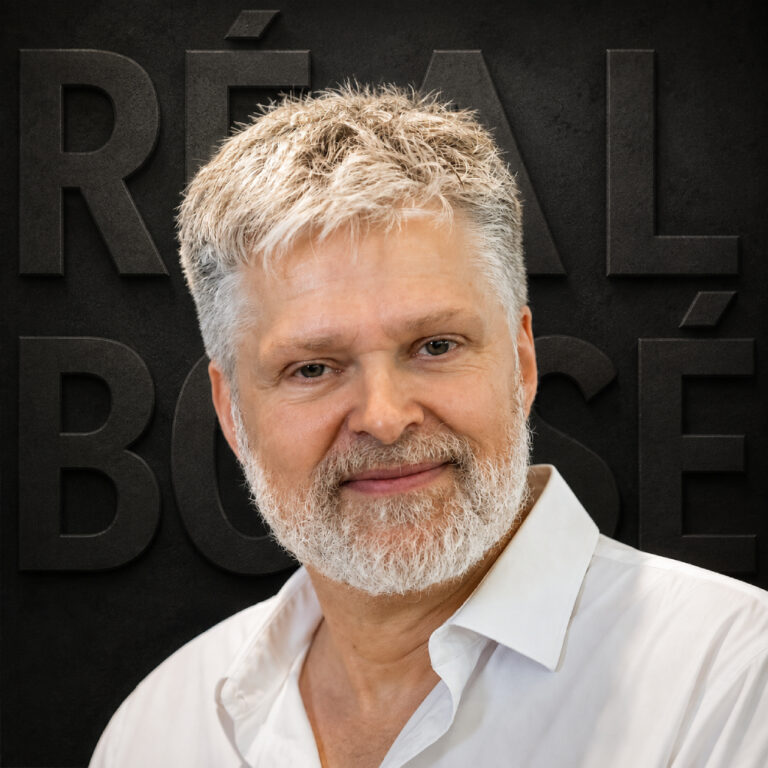
Designed for actors with some experience or graduates of theatre schools, this workshop was about becoming more aware of what we naturally project on screen. Through recorded exercises and targeted scene work, we could look at ourselves with fresher eyes, then adjust gestures and intentions for work that felt more precise, nuanced and controlled.
A passionate teacher whose goal is not only to make each student a better actor, but also a better person.
In June 2023, I took Camera Acting I — a 12-hour workshop offered by Mélanie Pilon, a teacher increasingly recognized for her rigorous and methodical approach. I have been working professionally as an actor since 2006 and I am still constantly learning, through workshops and through reading about acting techniques — from Stanislavski and Meisner to Shurtleff, Adler, Esper and Guskin’s How to Stop Acting. So I came into the workshop with a fairly broad theoretical background. Mélanie’s approach still gave me an excellent refresher and, more importantly, a more refined understanding of what acting for camera specifically asks of us, along with concrete tools for polishing my screen presence.
The workshop also placed a strong emphasis on individual preparation, encouraging us to choose scenes that pushed us beyond our usual comfort zone. It was demanding work, but in a supportive environment — the kind of structure that helps develop the autonomy an actor eventually has to bring to the profession.
Your Natural Casting: A Fantastic Exercise
Of all the exercises I encountered in Mélanie Pilon’s acting workshops, one stayed with me in a particularly strong way: an exploration of what I would call my natural casting. The starting point could not be simpler — stand neutrally in front of the camera. But that is where the exercise actually begins. Mélanie observes with surprising precision not only what that apparent neutrality communicates, but how far the same face and body can travel once different energies and intentions are introduced. She subtly adjusted my starting posture, then invited me to explore different facets, describing what she perceived at each stage, all the way to exuberance.
If you want to understand how someone may instinctively cast you before you have even said a word, this is a remarkably useful exercise. It became a lesson in perception, but also in the range that can already exist inside what we naturally project. I later encountered variations of the same kind of exercise in workshops with Réal Bossé, Luc Senay, Sylvie Moreau and Wendy Braun. Each version sharpened my awareness of what the camera sees before I consciously try to “play” anything.

Mélanie Pilon’s observations on natural vulnerability and sensitivity.
With your blue eyes and the way their shape slopes down just slightly, there is a sadness in your neutral expression. There is sensitivity there, a vulnerability. […] As a viewer, it naturally makes me want to dig deeper and find out what is behind that vulnerability. […] There is something in your eyes that is not very far from the child. I can easily imagine the little boy you were, with a great deal of sensitivity and gentleness. […] That part of you makes me want to know more and protect you.
Mélanie has a precise and nuanced way of naming the archetypes that emerge from a raw, unperformed presence. In my case, she observed that my neutral gaze — with the slightly downward shape of my blue eyes — naturally carried sadness, sensitivity and vulnerability. She said it created a desire, as a viewer, to “dig” and discover what might be hiding behind that vulnerability. She also saw something close to the child I had been: softness, sensitivity, and a quality that made her want to protect the person on screen.
[…] all of a sudden I can see that fragile, vulnerable little kid who was bullied — the one you almost want to save. [Your natural casting could work well for] characters who are maybe a little more introverted, more fragile…

Mélanie Pilon’s observations on the bullied / fragile archetype
Once we started changing the intention, that natural baseline became a surprisingly strong point of departure. When she asked me to imagine being intimidated, for example, the archetype of the vulnerable, introverted kid came through strongly — perhaps isolated, perhaps someone who had been bullied. Mélanie pointed toward broken, shy or submissive characters, even the image of the kind neighbour who lives alone with his ten cats. She also saw candour and fragility in the shy romantic lover, something she described as relatively rare in men and a particularly interesting part of my casting to explore.

What is really interesting is that your anger is almost silent. There is something of the hitman in it, a kind of clinical coldness […] that makes it feel dangerous. […] Your anger is not explosive; it is surgical, focused. […] I get the feeling you could kill without emotion. The character, not you! […] The combination of the softness in your features and your eyes with that cold intention creates this “whoa” effect that gives you chills.
The contrast became striking when she pushed me toward hardness. By imagining that I deeply hated the person on the other side of the lens, a silent, cold, surgical kind of anger appeared. Mélanie used the image of a “hitman,” pointing out that the combination of naturally soft features with a colder and more dangerous intention created something unsettling. Exploring pleasure in cruelty even brought out what she called a “psycho” quality — contained and deliberate rather than explosive.
Oh, you are the romantic lover! It is so beautiful. Romantic, but touching. There is something fragile about it. You really have a vulnerability and a candour that is quite rare in men. There is something really fun to explore in your casting there. It is a very interesting lane.

Mélanie Pilon’s observations on the shy / romantic lover
She also pushed me toward more composed and often comic character types. The mouthy little guy — not the actual tough guy, but the little rooster who talks big and gets everyone else to do the dirty work — seemed especially interesting and potentially distinctive for my casting. The same was true of the guy who is far too intense at a party, dances badly while thinking he looks sexy, and takes up much too much space. Mélanie saw potential there for memorable comic-relief or sidekick characters.

Mélanie Pilon’s observations on character roles / comic relief
It is the little rooster — the guy who mouths off to everybody but gets other people to do the jobs for him. That makes me laugh a lot. It is more distinctive […] there are not that many people […] who naturally carry that kind of casting. There is something about those character roles, the comic relief, the slightly off-to-the-side characters, that I find especially rewarding. […] They are really fun characters to explore, and often they are the ones people remember.
Finally, exploring a lawyer brought out something more cerebral, precise and procedural, suggesting another lane for more intellectual or professional roles.
Taken together, Mélanie’s feedback revealed a surprisingly broad casting range rooted in sensitivity and softness, but capable of shifting toward unsettling coldness, touching vulnerability or several kinds of character comedy. She kept returning to the value of character roles — sometimes more distinctive, more memorable and frankly more fun to play than the conventional hero — and to the importance of exploring the full range already suggested by one’s natural casting. It was an extremely useful mirror: not a prescription for what I am allowed to play, but information about what an audience may already be reading before I deliberately add anything.


To watch the complete analysis of my casting exercise with Mélanie Pilon, the video is available here.
To watch the complete analysis of my casting exercise with Mélanie Pilon, the video is available [here].
A pragmatic and deeply engaged teacher
One of the qualities that defines Mélanie Pilon’s approach is her constructive directness. She is not trying to flatter the actor. Her analysis is direct and honest, aimed at effectiveness and progress. That pragmatism comes with a remarkable effort to individualize the feedback, so each participant leaves with concrete avenues for further work suited to their own potential and objectives.
An experience that moves the work forward
The workshop grounds the actor in the concrete practice of acting for camera. Mélanie’s rigorous method and precise professional eye provide useful tools and a clearer understanding of the expectations specific to screen work. I left with a sharper sense of what I was doing, what the camera was actually reading, and where I could continue refining the work.
For actors looking for training that is structured, pragmatic and connected to the realities of screen acting, Mélanie Pilon’s workshops offer a strong environment in which to refine the craft and better understand the demands of the profession.
What stayed with me?
By the end of the workshop, I had a much more precise understanding of my natural casting. Mélanie revealed a range of roles I could inhabit without forcing, simply by staying faithful to qualities that were already visible on camera. The broader list below comes from the combination of several workshops I have taken — with Mélanie Pilon, Réal Bossé, Luc Senay, Sylvie Moreau and Wendy Braun — in which this exercise, or some variation of it, was used.
Knowing that it can take only three to five seconds for someone in an audition room to instinctively place an actor into a type, these are some of the roles and energies I now know I can naturally suggest:
Teachers, coaches and mentors
Inspiring teachers, caring educators, motivating coaches, passionate mentors — sometimes goofy, sometimes troubled, but always human.
Grounded, authentic characters who carry knowledge or experience and pass it on with heart and simplicity.
Empathetic and caring figures
Loving fathers, loyal friends, warm uncles, compassionate doctors or nurses.
Caregivers and supportive figures with gentleness, listening and humility; empathetic neighbours or trusted people whose calm presence reassures.
Sensitive authority figures
Agents, lawyers, business leaders, inspectors or priests who are both solid and human.
Calm leaders, thoughtful investigators, disillusioned but principled police officers, and decision-makers guided by a moral conscience.
Complex or tormented characters
Scarred soldiers, grieving men, obsessive researchers, secretive husbands, ambiguous neighbours, whistleblowers, or nervous but sincere defendants.
Men caught between vulnerability and restraint, between gentleness and danger.
Often they are wounded but dignified: lucid, quiet and full of human contradictions.
Character roles and comedy
Awkward but lovable coaches, mouthy little guys, fake tough guys, exuberant neighbours, and slightly overconfident party guys.
Colourful, distinctive supporting roles — often the ones people remember: comic relief, funny and human sidekicks, with an awkwardness that remains sincere and touching.
Other strong archetypes
Sensitive artists, proud and grounded workers, friendly postal workers, fishermen, men of faith or poetic researchers.
Accessible characters who carry something deeply human — sometimes spiritual, often calming.
In short
My natural range extends from the caring mentor to the protective father, from the thoughtful scientist to the shy romantic, from the compassionate caregiver to the wounded man — and even to the cold, silent killer.
It is a broad spectrum grounded in sensitivity and depth, able to move from reassuring calm to contained tension, from fragility to quiet strength.
The mirror offered by these different analyses — from Mélanie Pilon to Wendy Braun — keeps reminding me that the actor’s real work begins there: with a lucid, unapologetic acceptance of what is already present.