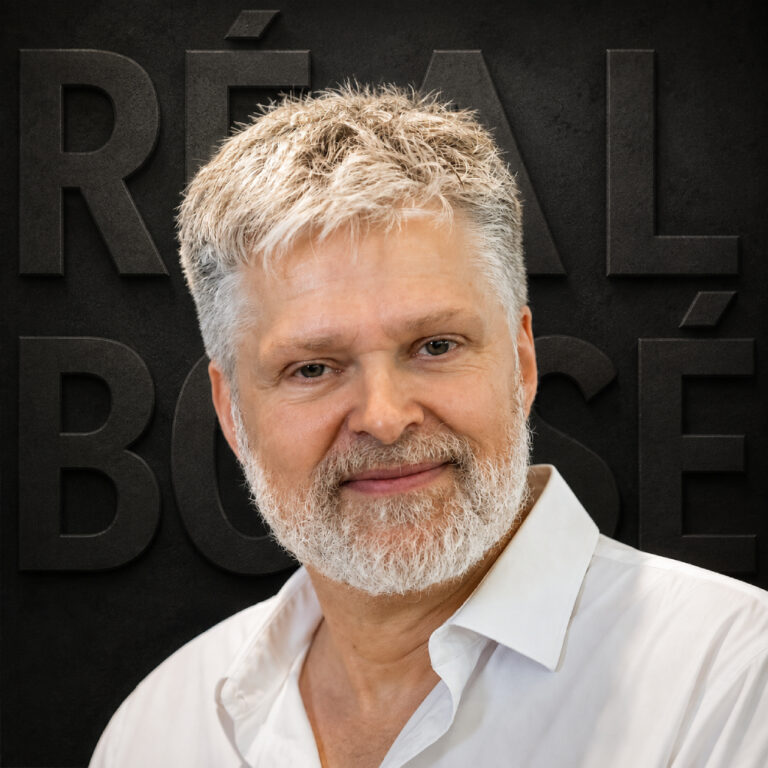
I first knew Richard Jutras as a teacher. In 2022, at Triple Threat Academy, I took Scene Work and On Camera with him. We worked scenes in depth: trying, going back, adjusting, then returning to the text and to what is really happening between the characters.
Over time, the teacher also became a friend. Getting to know him beyond the classroom helped me understand some of the qualities I had already sensed in his teaching. Richard is generous with his time, attentive and genuinely curious about others. He also has an optimism that is firmly grounded in reality. He knows the difficulties of the profession, but speaks about them without cynicism, with the sense that there is always something else to try, learn or build.
A career built over time
Richard’s career spans roughly forty-five years. He has worked in Montreal, Toronto, Miami, Havana, Austria and Los Angeles, in both French and English, across film, television and theatre.
His filmography is extensive. His credits include The Tournament, Stonewall, All You Can Eat Buddha and Dream Scenario. In The Whole Nine Yards (2000), he plays Agent Morrissey alongside, among others, Bruce Willis and Matthew Perry. In Dream Scenario (2023), he plays Jean in a film led by Nicolas Cage.
Those credits are impressive, but what strikes me more is the length of the journey itself. Continuing to work for that many years requires adaptability, openness to new teams and, above all, the desire to keep searching even when you already have a great deal of experience.
That is something I recognize very strongly in Richard.
Seeing him on stage
Richard is not only a screen actor. His theatre career is substantial, with productions including Prayer for the French Republic, The Hockey Sweater, Jeanne La Pucelle, Crazy for You, Bent and At the Beginning of Time.
I had the chance to see him perform in the latter at Centaur Theatre. I already knew him as a teacher, but seeing him on stage let me discover another side of his work.
He was simply brilliant: moving, authentic, funny and remarkably precise. Nothing felt forced. He could move from emotion to humour with complete ease, to the point where you quickly forgot about the actor and simply followed the character.
What struck me most was recognizing on stage some of the things we had talked about in class: listening, precision and the importance of not playing the result. It was all there, without the technique ever showing.
Richard also received a META in 2022 for his supporting performance in From the Stars in the Sky to the Fish in the Sea. That same year, he was nominated at the ACTRA Awards for Lifelike. He had previously received two Gémeaux nominations for the ensemble work in The Tournament.
Digging deeper instead of settling
What I remember most from my classes with Richard is the idea of not closing a scene too quickly.
We could work the same text in different ways, shift an intention, change the listening or simply try another direction. The text did not change, but our understanding of the scene could change completely.
It taught me not to become attached too quickly to a first idea.
A scene can work and still contain something else. On camera, very small adjustments can be enough: a thought that arrives earlier, a hesitation, a different kind of listening or a change in what the character is actually trying to get.
Richard taught me to stay curious long enough to let the scene breathe.
That search is not about making the acting more complicated. Quite the opposite. It is often about removing what feels manufactured, returning to the text and the scene partner, and letting something simpler and more alive emerge.
From teacher to friend
Over the years, I have discovered that this curiosity extends far beyond his work as an actor.
Richard is genuinely interested in people. He listens, asks questions and wants to know what others are trying to create or understand. When he gives his time or attention, he does it with a generosity that never feels calculated.
After so many years in a profession where rejection and uncertainty are part of everyday life, it would be easy to become disillusioned. Richard does not minimize those realities, but they have not diminished his ability to get excited about a project, a scene or someone else’s work.
When I met him in 2022, I obviously could not have known that our relationship would grow beyond the classroom. I knew the actor and was discovering the teacher. Over time, I came to know the man and the friend.
I remain grateful for what he brought to my work: the desire to keep searching a little longer, not to confuse mastery with certainty, and to stay available to what may appear in a scene.
After more than four decades in the profession, Richard continues to act, teach, listen and search.
To me, that may be what best connects the actor, the teacher and the friend: the desire to stay alive in the work and to keep digging until something truly begins to breathe.