Reflections on Butoh and Cyclic Experience, at Studio 303
By Martin Blais | Workshop, November 18–22, 2024 | V2
A scene repeats. The text returns, and so do the actions. Yet the character is going through the situation for the first time. As an actor, I am interested in that coexistence: I know what comes next, but I still need to be able to discover it.
From November 18 to 22, 2024, I returned to Studio 303 in Montreal to work with Denise Fujiwara in Butoh and Cyclic Experience. After the Timeless Form workshop in November 2023, this new week of five morning sessions proposed exploring the cycles of life, death, and rebirth through butoh. Taught in English, the training drew in particular on natural phenomena to bring the body and imagination into the work together.
During a round of introductions, I named my curiosity about presence. That question provides a thread for these reflections on the training. Breathing, the growth of a plant, or the return of movement after stillness became materials for exploring what transforms, disappears, and begins again. The connections to acting that I develop here are my own reading of these experiences.
Approaching cycles through the natural world
Life, death, rebirth: these words can invite large interpretations. In the workshop, Denise brought them back to observable phenomena. A tree dies and decomposes. Its matter becomes part of the soil and other forms of life. The disappearance of one form enters a process that continues.
This approach made it possible to work with rebirth as a transformation of matter, without having to settle a question of belief. The body could explore growth, decomposition, resistance, and beginning again through precise imaginary conditions. The workshop description itself announced this connection between natural phenomena, mortality, and creation in dance and performance.
This starting point seems fruitful to me for performance. It gives the imagination a task. Reflection on a cycle can then pass through a physical experience, with its nuances and surprises, instead of remaining a general idea to express.
Breathing, a return that is always different
The first cycle was already there: an inhalation, an exhalation, then the next breath. The instruction was to observe this familiar movement, to pay attention to how it unfolded and to its variations.
An apparently repetitive action thus became a particular event. The next inhalation arrived in a body that had already changed slightly: weight might have shifted, a tension might have eased, attention might have moved elsewhere. The breath returned in a new situation.
I recognize something useful here for rehearsals and takes. When a moment has worked well, it is tempting to want to do it again identically. Yet the partner has just breathed differently. A line has taken a different amount of time. The body is already receiving different information.
The work with breath invites me to value these variations. They may seem minimal, but they maintain contact with the present. The familiar frame of the scene remains; it still contains an experience to be lived.
Growing without knowing the form to come
The exploration of the seed and growth made this question especially clear. We know what a plant looks like. That knowledge can lead us to summarize the phenomenon too quickly: something opens, rises, and eventually flowers.
Denise invited us to work from the experience of what is in the process of growing. Parts develop, pressures appear, directions become more precise. Growth has to find its way through resistance and transformation. For the seed, what is happening has never happened before.
This proposition changes the relationship to the destination. If I am already aiming for the flower, each movement becomes a step toward a known image. If my attention remains on what is taking shape now, the event retains something unknown. I can discover difficulties, directions, or qualities that my summary had eliminated.
Repeating the exercise made the demand even more tangible. Denise asked us to let go of the seed or flower from the previous time. Changing places and beginning again helped set the research back in motion. The version already found could easily become choreography to reproduce, while the instruction asked us to go through a new growth.
The connection to character feels obvious to me. I have read the scene to the end. The character still does not know what is about to be said. Part of the work is to preserve that gap, to let each event produce its consequences before moving on to the next.
Time was also the subject of a very stripped-down proposition: opening a closed fist over one minute. The action was known, but the imposed duration required us to feel its stages. A tiny transformation could thus become an event rich enough to occupy the attention.
Letting the body propose what comes next
This availability was also explored through movement across space. A transfer of weight changes balance. A joint organizes itself differently. One part of the body leads the rest. The movement that has just happened may already contain a possibility for the next one.
The walking explorations made it possible to observe this precisely. By slowing the transfer of weight or changing the organization of the legs and joints, an everyday action stopped being self-evident. We had to feel how the body actually moved from one support to another.
Some propositions led to strange, sometimes funny walks. Their interest came from the seriousness with which we explored them. An unusual organization could reveal another presence, another relationship to space, or a possibility of movement we would not have invented by directly seeking an effect.
For me, this raises an interesting question about control. I can make choices while still letting the body inform me. The next action can emerge from what has just happened, and my initial idea can evolve with that information. I then have to accept losing a planned solution in order to pursue a more alive possibility.
The mountain and what the spectator receives
The work with the mountain approached another form of transformation. The image led us toward questions of mass, texture, organization, and presence. We had to let those qualities act all the way into how we imagined the material of the body.
An intervention Denise made to the observers clarified the issue: their attention could return to the human beings they were watching. They did not need to find the image of the mountain in what they saw. The performer’s inner score could remain unknown and still produce perceptible effects.
This idea connects with my work on subtext. I can rely on a very personal image to feed a scene. The spectator receives the way I am there, listen, or respond; they do not have to reconstruct the exact path that brought me there.
The exercise therefore required great inner precision while leaving the outward reading open. It helps me distinguish what makes a task active for me from what I am trying to make the audience understand.
Suspension also appeared around this research: a moment when movement is held, when something could still happen. This quality gives stillness a particular density. Attention keeps working even when movement becomes almost imperceptible.
Knowing the score and preserving discovery
Speaking about this relationship between preparation and surprise, Denise told us about her work with Natsu Nakajima. She had received a set choreography from her, yet had to dance it with the availability of improvisation. Knowing the sequence did not determine in advance the experience she would go through.
The instruction returned in our own passages: remember the tasks and their order, then begin before feeling completely ready. In this context, I understand it as an invitation to enter the work before mentally composing all of its effects. Preparation provides the reference points; action still allows us to discover how they will take form in the body.
Music could also pull the performer toward a response already suggested by its rhythm or atmosphere. Denise brought us back to the task so that it would remain active. This attention interests me in a scene whose atmosphere I know very well: I can still look for what is acting on me precisely, instead of letting that atmosphere decide every inflection.
For an actor, a fixed score is familiar: a text, movements, reference points with scene partners. This work sheds light on the freedom that remains within those commitments. Repetition can refine the conditions while preserving an experience that surprises the person going through it.
Exploring the end of a movement of life
Death was part of the material of the week. The exercises explored different conditions of it, with varying relationships to resistance, letting go, and the gradual disappearance of movement. The subject could be emotionally demanding; Denise acknowledged that difficulty and left open the possibility of stepping out of the exploration for a moment.
What interests me in this approach is the diversity it makes possible. Death is not reduced to a single dramatic expression. Depending on the condition being explored, struggle, fear, relief, or gentleness can occupy a different place. The performer has to remain attentive to the particular experience they are going through.
One exchange also clarified that the simplicity of a task did not require the movement to become smooth or always the same. The position in which the body found itself already opened certain possibilities. An ending could arrive from another orientation, another resistance, or another relationship to letting go. We had to look for those differences in the present experience, without systematically complicating the action to make it interesting.
The stillness that followed had its own duration as well. We stayed in it. Sensations persisted, the body continued to exist, and attention still had something to perceive. That time was part of the cycle being explored.
Then breath and movement could become perceptible again as a beginning. After giving so much attention to the ending and to stillness, the return of an inhalation took on another importance. An extremely simple action was enough to make renewal felt.
Feedback from the group brought out several readings of these passages. The return of breath could take on a sense of gratitude; stillness could leave a spectator unsure whether they were seeing an ending or the waiting for another beginning. These observations broadened the reach of the exercise: the cycle was also acting in the attention of the person watching.
For acting, I retain the place given to what comes after. We often prepare the major event of a scene with great care. What remains afterward in the body also deserves to be gone through. That time can profoundly change the way the next action begins.
Making fire more precise, widening the possibilities
The exploration of fire showed how much an image can shrink when we translate it too quickly into a general quality. Fire easily evokes intensity. Yet an ember, a flame, and a blaze are very different phenomena.
Associations around heat, combustion, light, oxygen, or transformation enriched the exploration. They offered properties to experience. An almost silent fire could demand as much inner attention as a more expansive manifestation.
This precision multiplies the possibilities for acting. If I rely on the image of fire to work on anger, I can ask myself what is burning, what remains contained, what grows, or what is being exhausted. These questions are my way of extending the exercise toward character; they avoid treating every anger as the same emotion whose volume is simply adjusted.
This demand for specificity connected with the walking explorations. Changing a tension or a level of movement already altered the possibilities of the body. It became possible to look for several responses from a simple instruction and to notice the ones we returned to spontaneously.
I find a useful discipline in this: make the proposition concrete enough that it can genuinely act, then observe the consequences.
Beginning again while accounting for what has changed
Through breathing, growth, the mountain, fire, and the explorations of death, the cycle took several forms. Each return happened in a body that had gone through something. The previous experience left a trace, even when the task began again.
This is what this training makes me want to preserve in my work as an actor. A new take offers a familiar frame, but it begins with the conditions of that precise moment. The text can remain identical while listening, physical support, and the relationship to time are renewed.
I also retain a greater attention to transitions: the end of a gesture, the stillness that follows, the first movement that returns. These passages have a life of their own. By giving them time, we allow possibilities to appear that anticipation could easily have covered over.
After this week, the idea of beginning again therefore seems more demanding to me than it appears. It asks us to return to the task with what we know, while looking at what has become different. Sometimes a single breath is enough to find that starting point again.
About Denise Fujiwara
A dancer, choreographer, and teacher born in Toronto, Denise Fujiwara founded Fujiwara Dance Inventions in 1991. Her career spans more than forty years of creation and teaching, along with sustained work in butoh, notably with Natsu Nakajima beginning in 1993. Her activities include stage performance, teaching, and dance film, with works presented in Canada and internationally. Read her official biography.
About Studio 303
Studio 303 has supported artists in dance and performance in Montreal since 1989. Founded as a place for training, rehearsal, and presentation, it developed an interdisciplinary vocation. Its professional workshops and residencies support research and creation by giving artists opportunities to experiment and evolve their practice. Discover Studio 303 and its history.
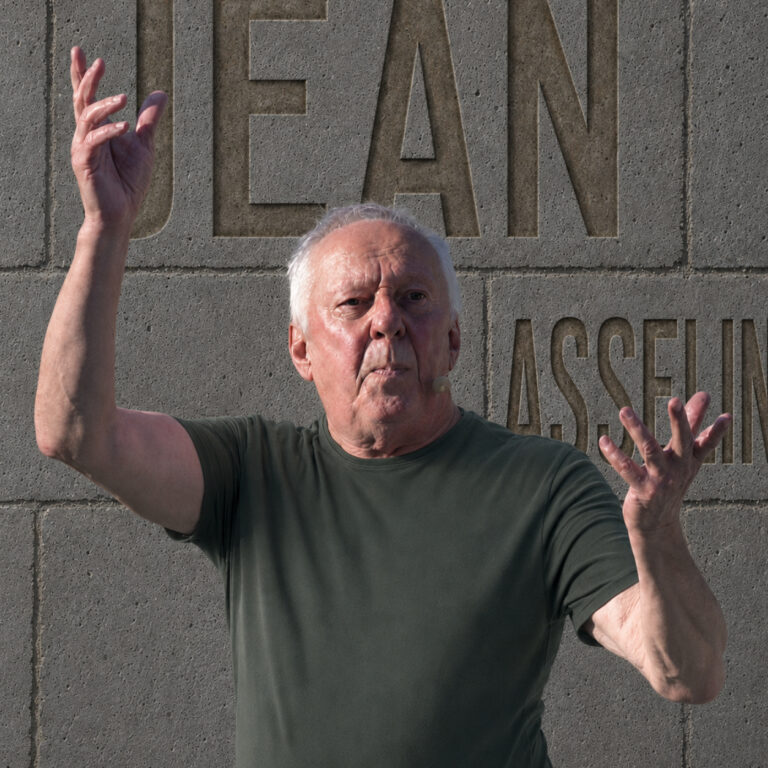
Image credit: Denise Fujiwara in Sumida River; photo by Cylla von Teidemann. Graphic montage by Martin Blais.