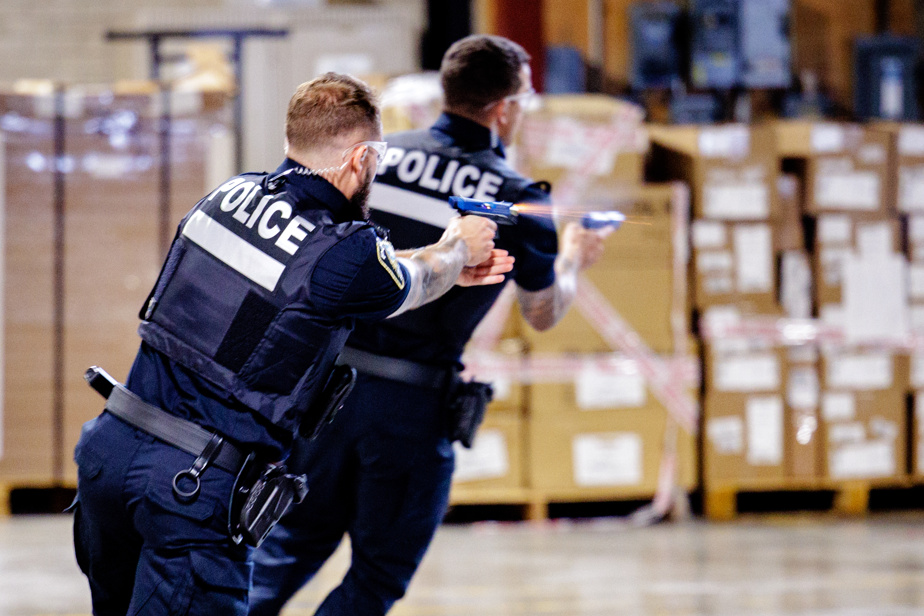
Before an exercise begins, I may receive a very detailed character, a scenario with specific actions to follow, sometimes even lines that must be spoken exactly as they are written. At other times, the framework leaves much more room for improvisation. In both cases, the challenge remains essentially the same: when a police officer finds themselves in front of me, the situation has to stop feeling like an exercise on paper as quickly as possible.
For the past few years, I have taken part as an actor — and sometimes as a stunt performer — in human simulations used in police training. I do not train police officers. I have no expertise to pass on to them about their profession, and I am obviously not there to judge their interventions. The exercises are designed and directed by professionals who know what they want the participants to work on.
My role is much simpler to define: I become the person in front of whom they have to put that training into practice.
A character who does not exist for an audience
On a film set, the character ultimately exists to tell a story to a camera and an audience. In a police simulation, the character has another function: they have to provoke an interaction that is believable enough for the person in front of me to genuinely have to observe, communicate, think, decide and adapt.
That changes a great deal about the way I act. I may portray someone who is calm, worried, impatient, distrustful, confused, shaken or agitated. The character may understand perfectly what is happening or, on the contrary, perceive the situation in a completely different way from the responder.
But the goal is never to make the scene more spectacular. It has to be accurate. If I suddenly decide to add an emotion, a piece of information or a reaction simply because I find it more interesting as an actor, I risk changing the exercise itself. And that would be exactly the opposite of my job.
Québec’s École nationale de police, in Nicolet, officially uses this form of experiential learning. It notably has a Service des comédiens whose members portray different characters during simulated interventions, according to the pedagogical objectives established for the training. Using actors is therefore not a small addition meant to make classes more lively. In some programs, we are genuinely part of the training apparatus.
Sometimes improvising. Sometimes following exactly what has been planned.
This is probably one of the aspects I find most interesting about this work: no two simulations ask exactly the same thing of the actor.
Some exercises are highly structured. The scenario may precisely define the situation, what the character knows, what must or must not be revealed, certain reactions and sometimes concrete actions that have to occur. There may also be text or certain lines that have to be followed. In that context, precision becomes almost a form of continuity. I have to be able to reproduce certain elements several times without gradually distorting them.
Other simulations are much more open. I then know the character, their emotional state, their history, their objectives and the limits of the situation, but I do not necessarily know how the person in front of me will address me or how the exchange will unfold. And that is when we enter territory I love as an actor.
You have to truly listen, not simply wait for your turn to speak. I can know very clearly where my character begins without knowing exactly how they will arrive at the end of the encounter. It is improvisation, but improvisation under constraint: the freedom exists within the framework, not instead of it.
When no one knows exactly what the next line will be
In a more open simulation, the police officer in front of me obviously has not been given my text, and I do not know theirs. A certain way of asking a question may provoke a different reaction. A tone of voice may change the character’s level of trust. A misunderstanding may persist. An intervention may calm the situation, leave it where it is or change the state of the person I am portraying.
My job is then to remain present enough to let that interaction have a real effect on me, without ever forgetting the parameters of the exercise. It is much subtler than an improvisation in which anything is allowed.
I also have to resist a fairly natural reflex for actors: helping your scene partner. On stage or in front of a camera, we often try to feed the other actor, to give them something to respond to. In a simulation, spontaneously offering information the character should not give can completely change what the person in front of me is supposed to discover on their own. Sometimes you therefore have to hold back, leave a silence, not make the conversation easier, and avoid becoming, without realizing it, a kind of prompter disguised as a character.
Playing distress without creating a spectacular character
Some of the simulations I prefer bring a police officer face to face with a person in psychological distress or whose mental state is impaired. The ENPQ notably offers de-escalation training with a practical component devoted to interventions with people whose mental state is impaired. I have personally been called to Nicolet several times to take part in scenarios of this kind.
For an actor, it is an exceptional playing field. But it is also one where caricature would be particularly easy — and particularly bad.
A person in psychological distress is not a collection of strange behaviours to display for the participant. They may be afraid, confused, understand some things and completely misinterpret others. They may be distrustful, want help while refusing what is being offered, be agitated or, on the contrary, almost completely withdrawn.
The interesting work lies in understanding enough of the character’s inner logic for their reactions to seem to come from somewhere. From there, I can genuinely listen to the responder and let what they do influence the encounter.
Some of these scenes can last long enough that you quickly stop being in a series of prepared reactions. You inhabit the character, listen, adapt, and sometimes have to maintain a complex emotional state throughout the encounter without pushing it artificially. For me, that is acting in an almost pure form.
Starting again without becoming mechanical
Then comes the second challenge: starting again. And sometimes starting again once more.
If several police officers experience the same scenario one after another, each should, as much as possible, encounter an equivalent situation. The character cannot be extremely cooperative with the first participant and much more difficult with the next simply because I feel like trying something different.
You therefore have to keep control of several variables: what the character offers spontaneously, their overall state, certain pieces of information, certain planned actions and the boundaries within which they can evolve. This repeatability is an integral part of simulation work. The same scenarios may be repeated with several participants or several cohorts, which requires real consistency from the performers.
But there is a trap. With repetition, you can begin to anticipate. You almost know which question should come next, you can feel certain moments approaching, and yet you have to prevent that knowledge from contaminating the next encounter. The person in front of me may be experiencing this situation for the first time. My character also has to experience it as if it were the first time.
It is a discipline I find extremely useful as an actor: reproducing with precision without reproducing mechanically.
Another form of continuity
This ability to repeat a situation while staying alive reminds me a great deal of certain challenges on a film set.
In film, continuity may require returning to a scene hours later, sometimes from another angle, while finding essentially the same state, the same rhythm and the same actions. In simulation, the principle is different, but the muscle being used is fairly similar.
You have to remember where you are emotionally, what the character knows, what they do not know, what they have just experienced and what they are supposed to do. Then you have to let something new happen within those parameters.
For me, this work therefore sits somewhere between scripted acting, improvisation, continuity and what you could almost call behavioural precision. It is not often that a contract allows you to work on all of those things at the same time.
When the body also becomes a simulation tool
Not every scenario is primarily based on dialogue, of course. Some have a much more physical dimension, and that is where my experience as a stunt performer becomes useful.
In that context, the work changes. You have to preserve the credibility of the situation while remaining extremely aware of your body, the environment and the safety parameters established by those responsible for the training. Some simulations also require protective equipment.
I will deliberately remain very general about this part. Police intervention methods and the precise mechanisms of the exercises have no place in an article like this. What interests me is what they demand from the performer.
Sometimes you have to repeat a physical action consistently, react with enough realism, remain fully committed without losing control, and understand the difference between creating the impression of a chaotic situation and actually creating chaos. That is a very fundamental stunt skill: what appears uncontrolled often has to be, in reality, extremely controlled.
Public documents from the City of Montreal also show that the SPVM has for several years used professional actors and stunt performers in different police training programs, notably through Communication Michel Verret, through whom I have personally obtained several of these contracts. In my own career, this alternation between acting work and stunt work is genuinely part of this activity.
Real simulation environments
Over the years, this work has taken me into several training environments. I have notably taken part in activities connected with the SPVM, worked several times at the ENPQ in Nicolet, and participated in simulations at the training centre of the Service de police de l’agglomération de Longueuil, in Boucherville. I have also taken part in police training in Laval.
The ENPQ openly embraces this approach to experiential learning: a training police station, facilities reproducing different work environments, police field exercises and its Service des comédiens are all part of its pedagogical approach. The SPVM also publicly states that it uses professional actors in certain training programs related notably to communication and de-escalation. In Boucherville, the SPAL likewise has a centre dedicated to acquiring and maintaining police skills, and its annual report refers to practical training in communication and crisis intervention.
From the outside, it would be easy to imagine that police training takes place mainly in classrooms. The reality is obviously much broader. At some point, knowledge has to meet a situation, and a situation becomes much more human when a real person is answering back.
A practice grounded in real-world training
Scenario-based exercises, actors and experiential learning are part of police training in Québec. La Presse documented this reality in a 2023 feature on SPVM recruits.
The following La Presse article is in French.
A close cousin: simulation in correctional settings
I have also worked in a parallel environment: the training of correctional officers. The distinction matters, because a correctional officer is not a police officer. But for the actor, several of the principles overlap.
These training programs can also use simulation spaces, characters, repeated scenarios and interactions that have to remain believable from one group to the next. In some of the activities I took part in, the roles were even assigned on site and there was nothing to learn word for word. You had to understand the character and the situation quickly, then step into the exercise.
Public contracts from the Government of Quebec explicitly refer to actors used for scenarios representative of real practice and for complex simulations in correctional training. Once again, the actor is not there to teach. The actor is there to make the learning concrete.
A strange laboratory for an actor
The more I think about it, the more I find that this work brings together a surprising number of skills I use elsewhere in my profession: learning a character quickly, respecting a text when it has to be precise, memorizing actions, maintaining continuity, improvising when the situation requires it, genuinely listening to your scene partner, adapting your acting without losing your objective, modulating an emotion rather than simply displaying it, repeating a scene without becoming mechanical, working physically while maintaining control.
And above all, understanding that the best performance is not necessarily the one that draws attention.
In some simulations, my work can be emotionally demanding or physically intense. In others, it essentially consists of listening and responding simply. Both can require exactly the same degree of precision.
That is probably what I like most about this facet of my profession: it rarely rewards the actor who wants to show that they are acting. It rewards the one who manages to make people forget that they are acting.
A scene where no one is a spectator
The comparison with a film set remains amusing. In film, I generally know where the camera is. There may be an extremely precise text. A director can stop the scene. A second take can go in a different direction. And later, the edit will determine what remains.
In a simulation, the person in front of me is not watching the scene. They are in it. There is no editing process that will come along later to correct the exchange.
When a situation is highly scripted, I have to respect what has been prepared. When it is more open, I have to accept not knowing exactly where the conversation will take us. And often, the most interesting work lies precisely at the boundary between the two: a rigorous framework, an unpredictable person in front of me and the obligation to remain truthful.
Being believable enough for the exercise to work
I will probably never know what these simulations actually change in the practice of the police officers who go through them. It is not my role to evaluate them. When the exercise ends, the instructors continue their work and I eventually return to my starting point to welcome the next person.
My job ultimately comes down to something fairly simple. For a few minutes, I have to be believable enough that the person in front of me is no longer merely applying a theory. They need someone to observe, listen to and understand; someone who may respond exactly as planned in the scenario or, sometimes, answer in a way they did not anticipate; someone who gives them, for a few minutes, a situation human enough for them to learn how to intervene in it.
Then we stop, reset everything and start again. For an actor, it is hard to ask for a better laboratory for the craft.