Guide de l’acteur
Article 21: Beyond Acting: Developing Specialized Skills — Voice, Movement, Stage Combat and More
Specialized skills can expand an actor’s instrument and open certain roles. The real question is which ones deserve enough time and depth to become genuinely useful.
We often talk about “special skills” as though they were a small section at the bottom of an acting résumé. In reality, some of them can transform your work deeply and sometimes become a very practical reason to hire you.
Voice, movement, stage combat, languages, music and certain technical skills are not merely marketing accessories.
When they are genuinely developed, they expand your instrument.
Your life is already a bank of skills
Before signing up for another class or training program, take inventory of what you already know how to do.
Your parallel career, sports, languages, serious hobbies and life experience may contain far more useful casting information than you realize.
In my case, aeronautics gave me real familiarity with a technical world, its procedures, vocabulary and the way certain objects are handled — things I could not have learned as naturally the night before a shoot.
Physical disciplines have also given me awareness of the body, distance and the scene partner that feeds my camera work.
The point is not to turn every hobby into a marketing claim.
It is to recognize that your whole life feeds the performer.
Voice: more than good diction
A trained voice is not a “perfect” voice.
It is an available voice.
Vocal work can improve breath, articulation, projection, endurance, resonance and, above all, the ability to carry thought without unnecessary force.
That is obviously essential in theatre and voice work, but it matters on camera too. A tense, held or manufactured voice can limit acting long before we consciously notice it.
We will go deeper into this in Article 22 on vocal training.
Movement: your body speaks before the text
Before a character says a word, we already see how they enter a room, sit down, take up space, touch an object or avoid someone’s gaze.
Movement work — dance, mime, clown, physical theatre, yoga, martial arts or other disciplines — can make an actor more aware of habitual patterns.
The goal is not necessarily to become a dancer.
It is to avoid giving every character exactly the same body.
I have found it especially useful to explore different physical approaches because they force me out of my usual reflexes. A character does not walk differently because you decided to “give them a walk.” They move differently because their centre, tension, history and relationship to space are not yours.
Stage combat: knowing how to fight is not the same as knowing how to perform a fight
This distinction is essential.
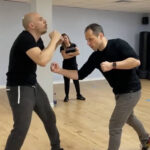
Martial arts and stage combat are not the same skill.
Stage combat is built on safety, choreography, distance, angles, rhythm, repeatability and trust between partners.
Someone experienced in martial arts may even need to unlearn certain reflexes so a scene partner is never put at risk.
Conversely, an actor with no martial background can look extremely convincing on screen with good choreography and specialized training.
We will return to this in detail in Article 23 on stage combat, movement and safety.
Languages and accents
In Canada, an additional language can become a very concrete advantage.
But describe your level honestly.
“French: native,” “English: bilingual” or “Spanish: conversational” gives far more information than a list of languages without context.
Be even stricter with accents.
If you list an American, British or regional accent, make sure you can sustain it throughout a scene and still receive direction without losing it.
A credible accent usually requires much more than imitating a few sounds.
Music and singing
An actor who genuinely plays an instrument can give a director enormous freedom. I experienced that while preparing my musician role in Bye Bye Grandma.
The same applies to singing.
Again, be clear about level.
“Piano: advanced” and “piano: basic” create very different expectations.
Do not underestimate how quickly a production will discover the difference.
Improvisation: learning to stay available
Improvisation, which I have worked on with Anik Matern among others, develops skills that transfer directly to acting: listening, speed, acceptance of the unexpected, behaviour, rhythm and the ability to keep going when the plan changes.
It is obviously useful in comedy, but its value goes much further.
An actor who improvises well is not someone who constantly adds jokes or extra lines.
It is someone who remains available to what is actually happening.
Professional and technical skills
Flying, riding a motorcycle, working in healthcare, handling tools, cooking professionally, understanding police procedures, horseback riding or playing a sport at a high level can give a character immediately visible authenticity.
But distinguish real experience from superficial familiarity.
And when a skill requires a licence, certification or legal qualification, never imply that you have it if you do not.
A skill can open a role.
A lie can close far more than one.
Do not collect skills for the sake of collecting them
Your résumé is not a game where the longest list wins.
Ten beginner-level skills may be worth less than one or two specialties you have truly developed.
I like to think of development as a “T.”
The horizontal bar represents broad actor literacy: voice, body, camera, text, improvisation and understanding how a set works.
The vertical bar represents one or two areas where you develop real depth.
For example: complete actor + strong stage-combat performer.
Complete actor + professional singer.
Screen actor + natural bilingualism + aeronautical expertise.
That combination is often what becomes distinctive.
How should you choose your next skill?
Ask three questions:
- Does this skill directly improve my instrument?
- Does it align with roles I can realistically pursue?
- Am I interested enough to practise it for a long time?
The third question is fundamental.
A skill chosen only for marketing is rarely practised long enough to become genuinely useful.
Do an annual audit
Once a year, revisit the “skills” section of your profiles.
Classify each item:
- Professional level: I could be hired specifically for this.
- Advanced: I can do it credibly with little preparation.
- Intermediate: real but limited skill.
- Beginner: basic familiarity.
Then remove anything you no longer practise.
That honesty can prevent very uncomfortable situations on a set.
In short
Specialized skills are not only there to add another line to a résumé.
They expand your acting vocabulary and can make certain roles immediately more credible.
Start with skills that feed the instrument — voice, body and listening — then develop a few specialties that genuinely connect to your path.
In the next two articles, we will go deeper into two especially important areas: voice, then movement and stage combat.
Previous article: Theatre and Film Schools in Canada: Where Should You Train?
Continue the Actor's Guide







Related articles

Article 22: Voice Training for Actors: Understanding Fitzmaurice, Linklater and the Essential Foundations

Article 23: Stage Combat and Movement: Safety and Versatility for Actors

Article 20: Theatre and Film Schools in Canada: Where Should You Train?
