With OMNIBUS and TOHU, we invited the public to make an immense grey fabric breathe, then disappear beneath it and become the relief of a living work.
Inert Matter Waiting for Bodies
The fabric onstage measured roughly six by ten metres. Lying flat, it told no story yet. First, we had to give it volume. Everything began with a collective gesture: taking hold of its edges, lifting it together, and trapping a mass of air beneath it. The fabric rose like an immense parachute.
Jean emphasized the solidarity the gesture required: a chain, he reminded us, is never stronger than its weakest link. Each person therefore had to carry their share of the movement, in the same rhythm as everyone else. Then, with that broad storyteller’s smile he wore whenever he was about to deliver a seemingly contradictory formula, he gave us the secret to lifting such a mass of air with a fabric this vast: hurry slowly. For a few seconds, we built a roof held up by nothing more than the coordination of our arms and the air we had managed to trap.
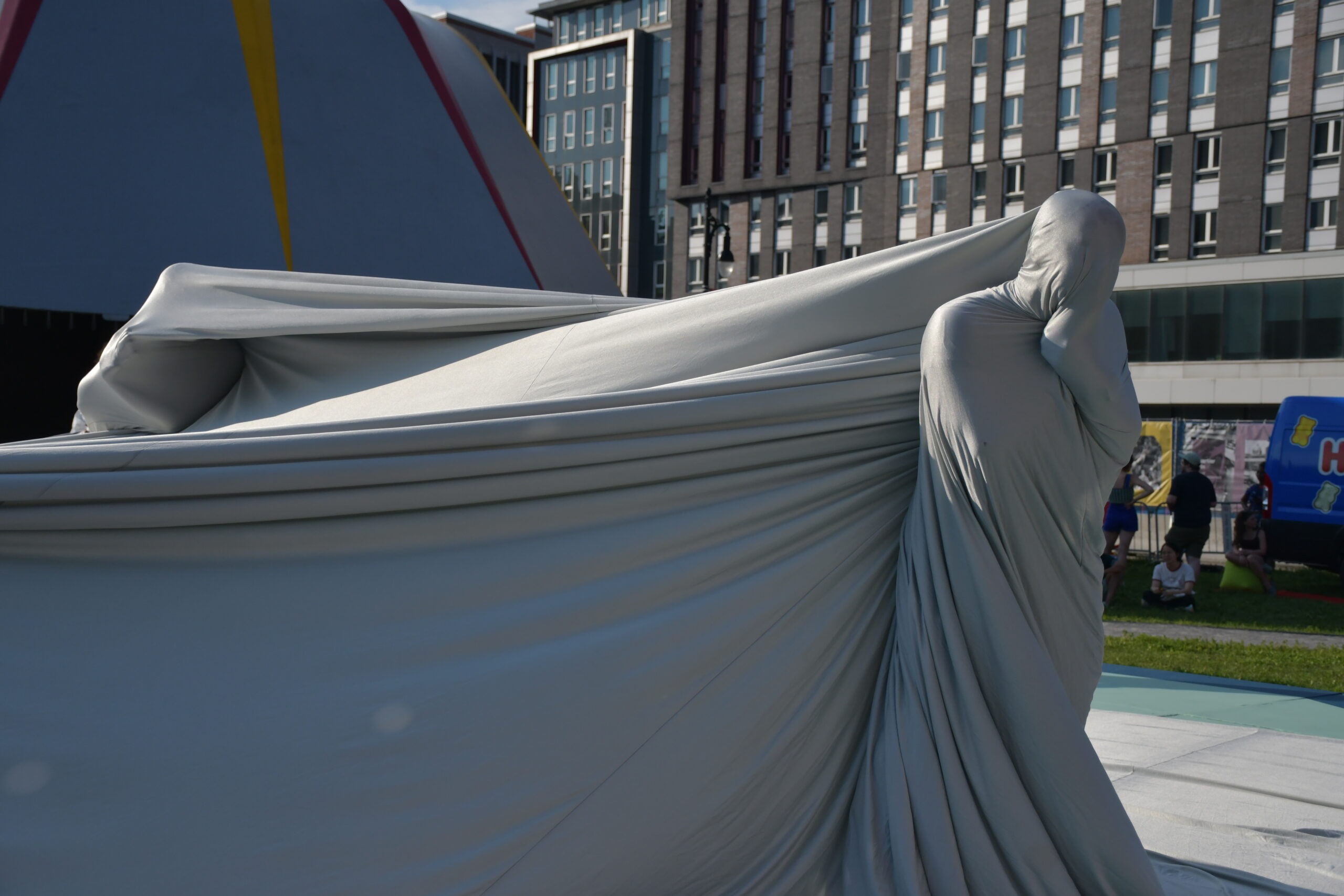
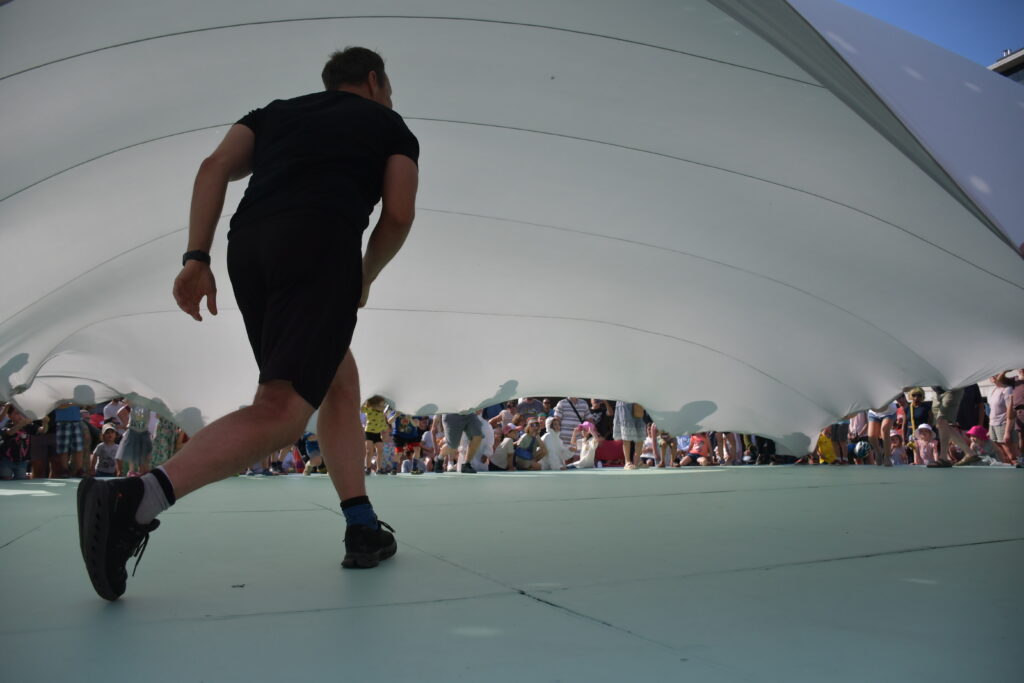
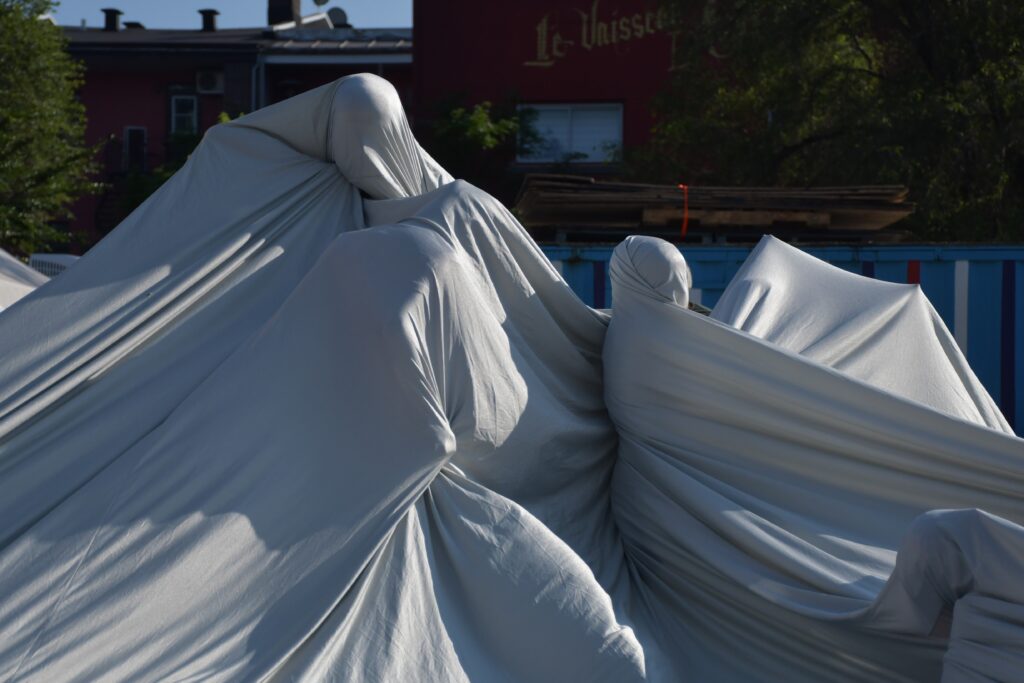
On the turquoise stage of the CircoThèque, in full sunlight, the fabric did not remain simply grey. It turned silver, sometimes almost white. Light travelled across its folds and made visible the slightest pressure from a knee, a shoulder, or a head. The fabric was not merely hiding the bodies; it was recording each of their gestures.
Then the fabric began to descend. That was when the real landscape appeared.
Jean had suggested that Annick and I guide the lift from the centre rather than from the outer edges. We could then slip beneath the fabric and help the participants produce the vertical forms he called “beautiful stalagmites.” Outside, a minimum of four people folded down the corners to keep the air from escaping too quickly. What looked free and organic actually depended on a very precise mechanism: the right moment, the right tension, the right distribution of bodies, and the ability to sense what was happening without always being able to see it.
Cloud Shovelers, Tectonic Plates, and Corner Folders
Jean was not simply asking for volunteers. During each performance, he invited the “Pelleteurs de nuages” (“Cloud Shovelers”), the “Plaques tectoniques” (“Tectonic Plates”), and the “Rabatteurs” (“Corner Folders”) to join us. Those names immediately changed the nature of the invitation. People were not stepping onto a stage merely to follow instructions. They were being given a role in a world that was already beginning to appear.
The “Rabatteurs,” the “Corner Folders,” brought the fabric’s corners back to the ground to hold in the air. They kept the cloud from escaping. But the name suggested something else as well: they were also folding down the distance between those who watched and those who made. In Utopian Landscapes, the public was never condemned to remain an audience. At any moment, someone could enter the mechanism, become necessary, and alter the work.
The “Tectonic Plates” evoked the slow movement of masses that reshape a territory as they collide or pull apart. Beneath the fabric, our bodies became precisely that. They moved closer, drifted apart, pushed a shoulder or a back upward, changed axis, and created a fault, a ridge, a temporary mountain. The landscape looked natural, but it was composed of human decisions, partial perceptions, and minute adjustments, then, finally, of a solid and fully committed stillness—as much as possible. At times, the children taking part would keep running everywhere beneath the surface, despite our invitation to choose a position and stop moving.
A “Cloud Shoveler,” normally, is someone who dreams too big, someone who stirs the impossible. Here, the expression became almost literal. We had to sculpt the fabric and organize the final tableau once the air trapped beneath its surface had escaped and the hills and valleys were beginning to appear.
The audience formed a tight circle around the stage. Children, often kneeling in the front row, watched from the same level as the fabric itself. That proximity made the boundary almost meaningless: one moment, you were watching a form; the next, you could take hold of an edge, keep down a corner, or disappear beneath it.
Creating an Image We Could Not See
Once beneath the fabric, we lost the spectator’s point of view. Yet it was not dark. Sunlight passed through the cloth and transformed it into a luminous ceiling; at ground level, the audience’s faces remained visible like a frieze around us. The space tightened. We had to locate ourselves through the tension of the fabric, the nearness of another body, a movement sensed more than seen, and our intuition. We were building an image whose shape we could not truly know. That is one of the things that interested me most about the experience. As an artist of the body, I am used to seeking precision, but that precision often relies on a gaze: that of a teacher, a director, a camera, a scene partner, or the audience. Here, the final form escaped us. We had to trust sensation, accept that we possessed only part of the information, and work for a whole that no one beneath the fabric could fully comprehend.
Fortunately, the photographers were there to reveal a few fragments to us afterward, and to show us some of the magnificent ephemeral utopian landscapes we had helped create without ever being able to see them from the inside.
There was also a small gift for the participants: photographers moved all around the stage to capture some of these forms on Polaroid. The photographs were then given to the participants free of charge, both as a souvenir of the experience and as a thank-you for taking part.
Jean and Catherine could see what we could not. From outside, they could also sometimes ask one form to rise, another to shift, a movement to continue, or to stop. Annick and I served as physical reference points inside the structure. We had to enable adults and children who did not necessarily have movement experience to understand, through their bodies, how a shared image could emerge.
Between Animal and Mineral
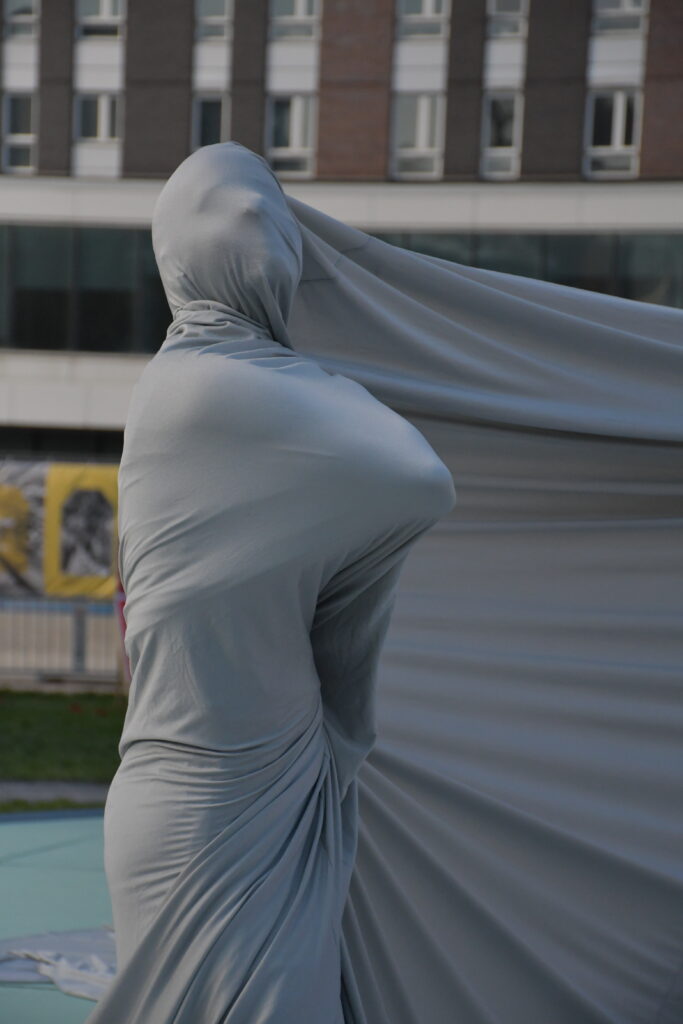
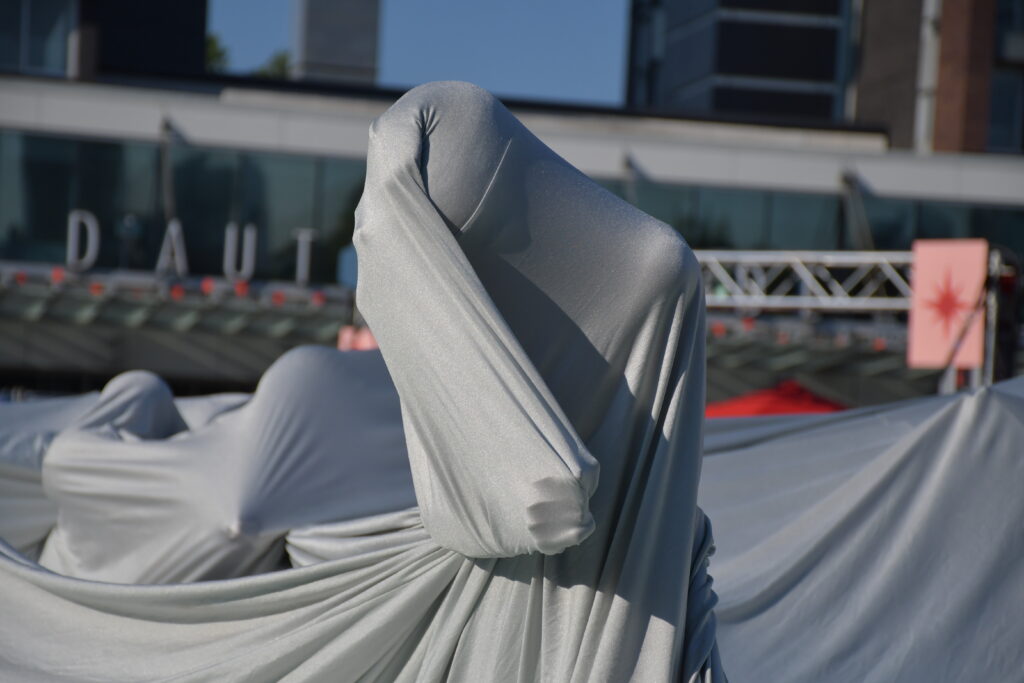
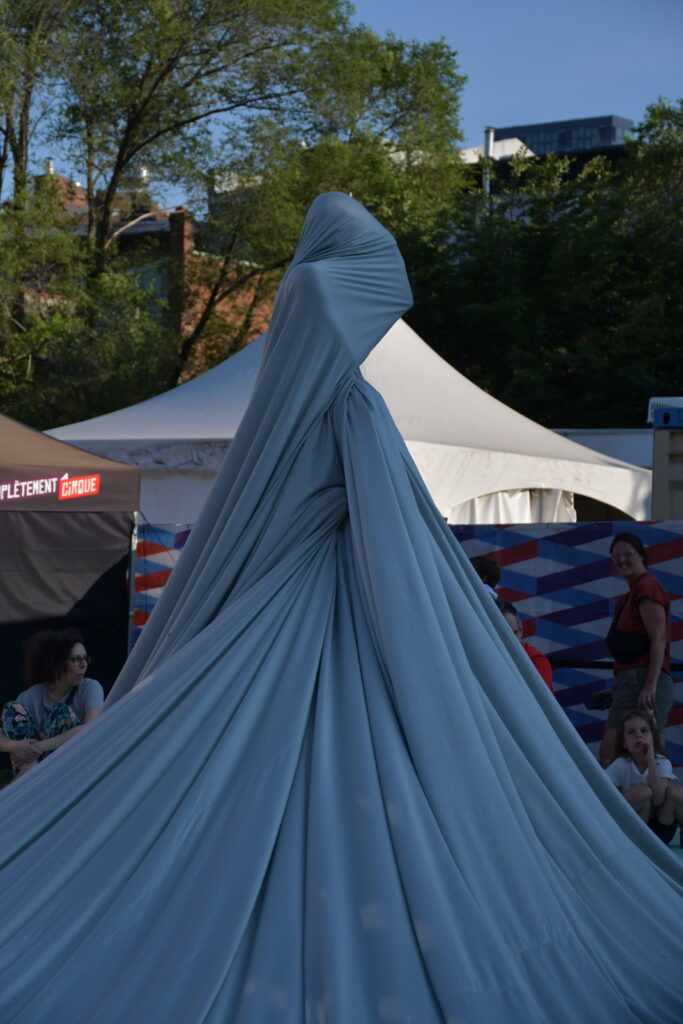
The forms Catherine described existed “halfway between the mineral and the humanoid.” Movement sometimes gave them an animal quality: a mass seemed to breathe, a creature advanced without revealing its limbs, an immense skin contracted. Then came stillness. The living form hardened into rock, column, terrain, or outgrowth.
I did not fully discover those landscapes until I looked at the photographs. Depending on the distance, the same form could be read as a mountain, a collapsed tent, an animal, or a faceless body. Up close, the folds gathered around a head, an elbow, or a hip; from farther away, those anatomical markers disappeared into a network of ridges and valleys. The cloth did not erase the human body. It made it impossible to decide exactly what that body had become. The white hooded suits carried the metamorphosis further: even after emerging from beneath the fabric, some figures still seemed to belong to the material.
The contrast between movement and stillness was not decorative. It required a precise sense of space and timing. When should we move? How far? At what moment should we stop transforming the form so that it could become legible? One movement too many could erase the landscape. Stillness arriving too soon could prevent it from being born.
The signal to suspend movement also allowed Sylvie to photograph the composition. Photography was not merely a souvenir taken after the activity. It was part of the work. The landscape existed for only a few seconds, until the air escaped or a body changed position. The photograph held on to what we had created without being able to see it ourselves. It became the lasting trace of a sculpture destined to disappear.
A Memory of OMNIBUS, Not a Reconstruction
The project carried a much older artistic memory. It returned to a principle OMNIBUS had explored in D’où venons-nous… (Where Do We Come From…), a work from the late 1970s inspired by L’Enveloppe (The Envelope), a solo by Étienne Decroux. Jean and Denise had just returned from studying with him. The fabric already made it possible to conceal the individual and transform several bodies into a single sculptural form.
Without trying to reproduce the past, Utopian Landscapes took up a principle, not a production. What belonged to the history of OMNIBUS became here an experience offered to the public. Transmission did not happen through explaining a technique to attentive spectators, but through its immediate activation in bodies of all ages.
I love this way of transmitting knowledge. It does not dilute a demanding practice in order to make it “accessible.” On the contrary, it preserves its core — precision, listening, composition, the relationship between movement and visual dramaturgy — and then invents a situation in which non-professionals can genuinely experience it.
Five Times, Never the Same Work Twice
The five workshop-performances took place on Jul 2, 2026 , Jul 3, 2026 , Jul 4, 2026 , Jul 5, 2026 , and Jul 7, 2026 as part of Montréal Complètement Cirque, with TOHU. On the site just north of BAnQ, at the corner of Berri and Ontario streets, each workshop-performance lasted approximately fifty minutes to an hour.
Five performances, then, with no possibility of reproducing the previous one exactly. The fabric remained the same. The basic mechanism remained. Jean and Catherine’s directions guided us. Yet the bodies changed, the hesitations changed, and the air itself refused to behave the same way twice. Each group invented a different topography.
That is also why the word performance feels both accurate and insufficient. There was certainly something to watch. Powerful images appeared before us. But the work did not exist only in its visible result. It also lived in the way a group of strangers learned, within minutes, to breathe together beneath the same skin.
Utopia, for a Few Seconds
What stays with me from Utopian Landscapes is not only the strange beauty of those grey volumes suspended somewhere between body, animal, and stone. It is the quality of presence they demanded. Beneath the fabric, no one could impose a personal idea of the landscape. We had to feel what the others were already building, find our place within it, sometimes support a form, sometimes withdraw, sometimes become the point that allowed everything else to hold.
Utopia, then, was not the perfect image achieved at the end. It was this temporary agreement. For a few seconds, children, adults, artists, and passersby accepted that they would no longer be seen separately. Every body mattered, but no one needed to occupy the entire image. We disappeared as individuals in order to become terrain together.
Eventually, the air escaped. The fabric sky fell. The mountains became people again. We had to emerge, take our places around the cloth, and begin again with another group.
Perhaps that, in the end, is a utopian landscape: not an ideal world contemplated from a distance, but a fragile form we agree to build with others, knowing it will not last.
Variations on Utopian Landscapes
Photos by Sylvie Chartrand